
- 0
- 857 words
NADI, Fiji — The co-organizers of this year’s UN climate summit have announced a new tactic to break the deadlock of COP negotiations: a “presidency-led decision” — a summary text they will prepare in advance and put to a vote at COP31 in Antalya, aimed at keeping the 1.5°C warming limit within reach.
Australia and Türkiye unveiled the plan on Thursday, the closing day of the COP31 pre-COP meeting in Fiji, where thousands of delegates gathered this week and a group of 30 countries also visited Tuvalu, the low-lying atoll nation already laying plans to relocate its population of 10,600 if the ocean consumes it.
What the presidency-led decision would do
Australia’s climate minister Chris Bowen, who serves as COP31’s President of Negotiations, said the prepared text would, in theory, set a firm and realistic agenda — cutting the endless hours of gruelling negotiations that often dominate COP meetings before votes are taken on individual technical points.
“We feel that a presidency-led decision gives us the best chance of a strong and ambitious outcome at COP31,” Bowen said. The goal, he added, is to send the signal to follow the science to keep 1.5 degrees within reach, even against scientific evidence that the world will overshoot it — “for as little and as short as possible,” he said.
According to the organizers, the decision would focus on practical commitments such as electrification — replacing technologies that burn fossil fuels directly, like diesel cars and gas heating, with electric alternatives. This builds on the COP31 presidency’s earlier “35% by 2035” electrification target, unveiled at a UN event in New York in September.
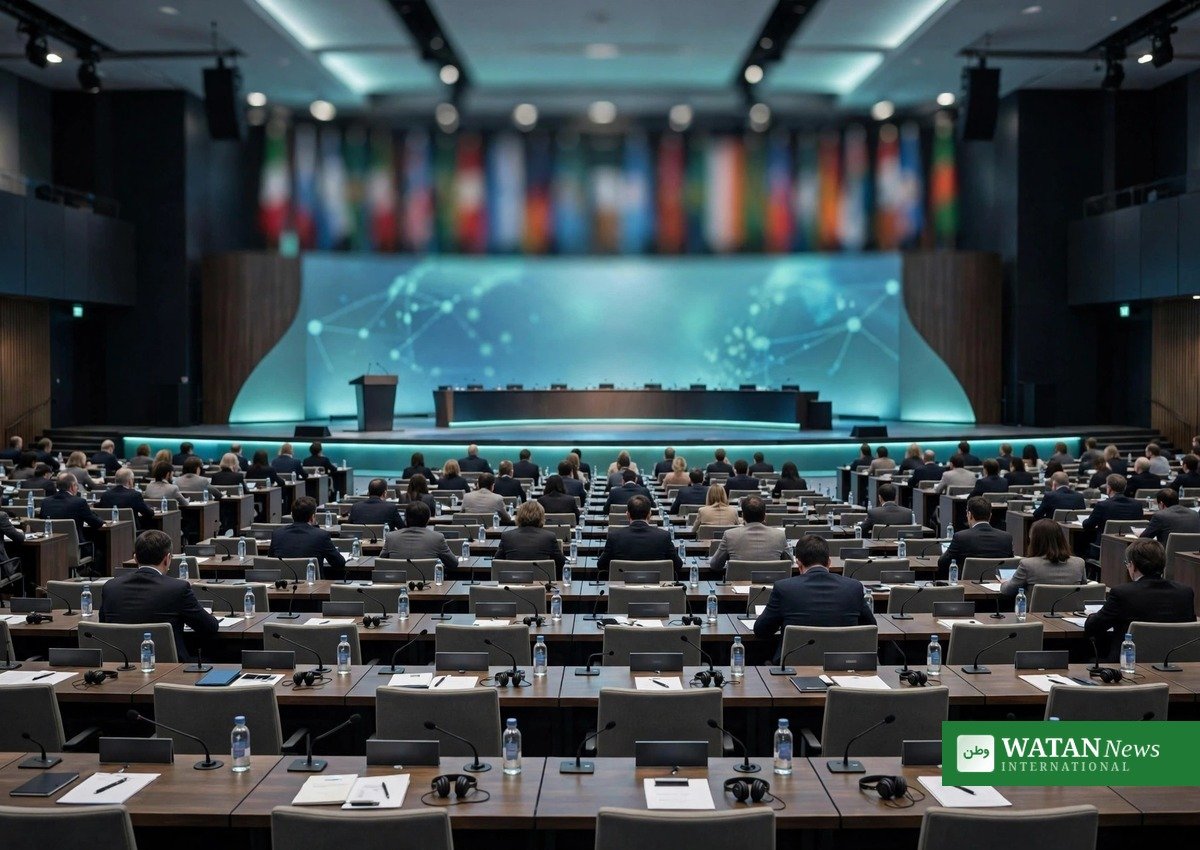
Delegates at an international climate summit plenary. The COP31 organizers say a presidency-drafted decision text could shorten the usual marathon negotiations. (Illustrative image)
Kurum: 1.5°C “a matter of survival”
COP31 President Murat Kurum, who is also Türkiye’s environment minister, used the closing press conference in Nadi to warn that too many countries are shirking their responsibility to cut emissions.
“Today is a time where everyone is running away from responsibility,” Kurum said. “We do not have a single minute, a single day to lose.”
Reflecting on his visit to Tuvalu on Tuesday, Kurum said mothers and children on the tiny island nation — thin strips of land on average around two metres above sea level — are under increasing threat from every high tide. He contrasted Tuvalu’s disappearance with NATO nations’ commitments to raise defence spending to 5% of gross domestic product: “What good is defending your borders if there is no livable world left?”
Pacific nations push oceans and finance to the top
Pacific island nations used the pre-COP platform in their region to embed their priorities into the COP31 agenda: better access to funding for resilience projects, protection of the oceans, and holding warming beneath 1.5°C above pre-industrial levels.
Nearly 200 nations committed a decade ago under the Paris Agreement to try to keep global temperature rises to that safer threshold. Scientists agree that warming above 1.5°C poses grave risks, and an August UN report found sea levels rising at a record pace — driven by warming oceans and glacier melt — with Pacific island countries experiencing sea-level rise at twice the global average. The report warned up to 1.2 billion people could be displaced by 2050.
Pacific climate envoy Tina Eonemto admitted the COP process was tiring — “The way that the COP process works is not great, I’ll be very frank” — but said Pacific nations had put their hopes “front and centre” and welcomed the plan for a presidency-led decision at the end of COP31.
Not everyone was convinced. Shiva Gounden, Head of Pacific at Greenpeace Australia Pacific, called the pre-COP outcomes “a drop in the ocean given the scale of need,” warning it is “like taking a glass of water to a burning house” without urgently addressing fossil fuel expansion — the root cause of the existential threat facing Tuvalu, Fiji and all Pacific countries.
What happens next
COP31 will be held in Antalya, Türkiye, from 9 to 20 November 2026, including the World Leaders’ Summit. Under the unprecedented joint arrangement, Türkiye hosts and presides while Australia leads the formal negotiations.
With the formal agenda light on headline items and fossil-fuel phase-out still not a formal negotiating item, the presidency-led decision is shaping up as the organizers’ main instrument for an ambitious result. Türkiye and Australia have promised a predictable process with no last-minute surprises — a pledge Pacific delegates will be watching closely in Antalya.
For more on the road to Antalya, see Watan News’ coverage of UN chief Guterres urging climate finance delivery ahead of COP31 and the Climate desk’s full coverage.
FAKTA: The COP31 presidency-led decision
- What: A summary decision text prepared in advance by the COP31 organizers for countries to vote on in Antalya.
- Who: Jointly driven by Türkiye’s COP31 President Murat Kurum and Australia’s President of Negotiations Chris Bowen.
- Goal: Ambitious action to keep the 1.5°C warming limit within reach, with a focus on electrification.
- When: Announced 8 October 2026 at the close of the Fiji pre-COP; COP31 runs 9–20 November 2026 in Antalya.
- Pacific ask: Oceans protection, easier access to climate finance, and holding the 1.5°C line.
Author

usman2344913@gmail.com
Related Posts
Australsk studie: Politikere undervurderer borgernes støtte til klimahandling
- 0
- 564 words
Canberra — Lokale politikere i hele Australien undervurderer markant, hvor stærkt befolkningen ønsker klimahandling, viser ny forskning fra University of Queensland, der...
Read out all
آسٹریلوی تحقیق: سیاست دان موسمیاتی اقدام کی عوامی حمایت کا اندازہ کم لگاتے ہیں
کینبرا — کوئنز لینڈ یونیورسٹی کی اس ہفتے جاری ہونے والی نئی تحقیق کے مطابق آسٹریلیا بھر کے مقامی سیاست دان موسمیاتی...
Read out all
Australian Study: Politicians Underestimate Public Support for Climate Action
- 0
- 554 words
Canberra — Local politicians across Australia seriously underestimate how strongly the public wants climate action, according to new research from the University...
Read out all
COY21 i Antalya: Verdens største ungdomsklimakonference sætter dagsordenen før COP31
- 0
- 599 words
ANTALYA, Tyrkiet — Om mindre end en måned åbner verdens største samling af børn og unge med fokus på klimaforandringer dørene i...
Read out all
سی او وائی 21: انطالیہ میں نوجوانوں کی عالمی موسمیاتی کانفرنس، کاپ31 سے پہلے اہم ایجنڈا
انطالیہ، ترکیہ — ایک ماہ سے بھی کم وقت میں موسمیاتی تبدیلی پر بچوں اور نوجوانوں کی دنیا کی سب سے بڑی...
Read out all
COY21 in Antalya: World’s Largest Youth Climate Gathering Sets Agenda Before COP31
- 0
- 649 words
ANTALYA, Türkiye — In less than a month, the world’s largest gathering of children and young people focused on climate change will...
Read out all