- 0
- 780 words
A Panama 7.7 earthquake struck southern Panama on Friday, shaking buildings across the country and sending thousands of people into the streets. The powerful tremor collapsed buildings in towns near the epicenter and prompted a tsunami warning for much of the Pacific coast of Central America.
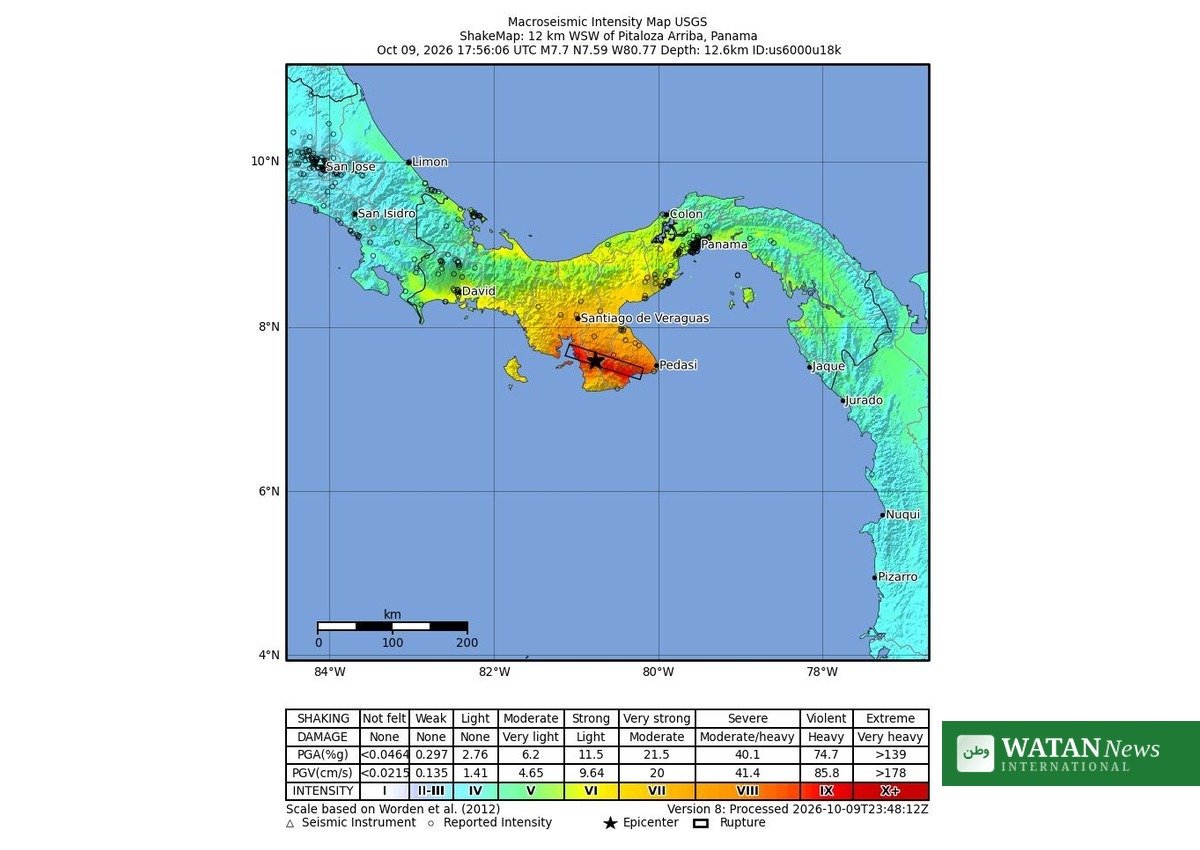
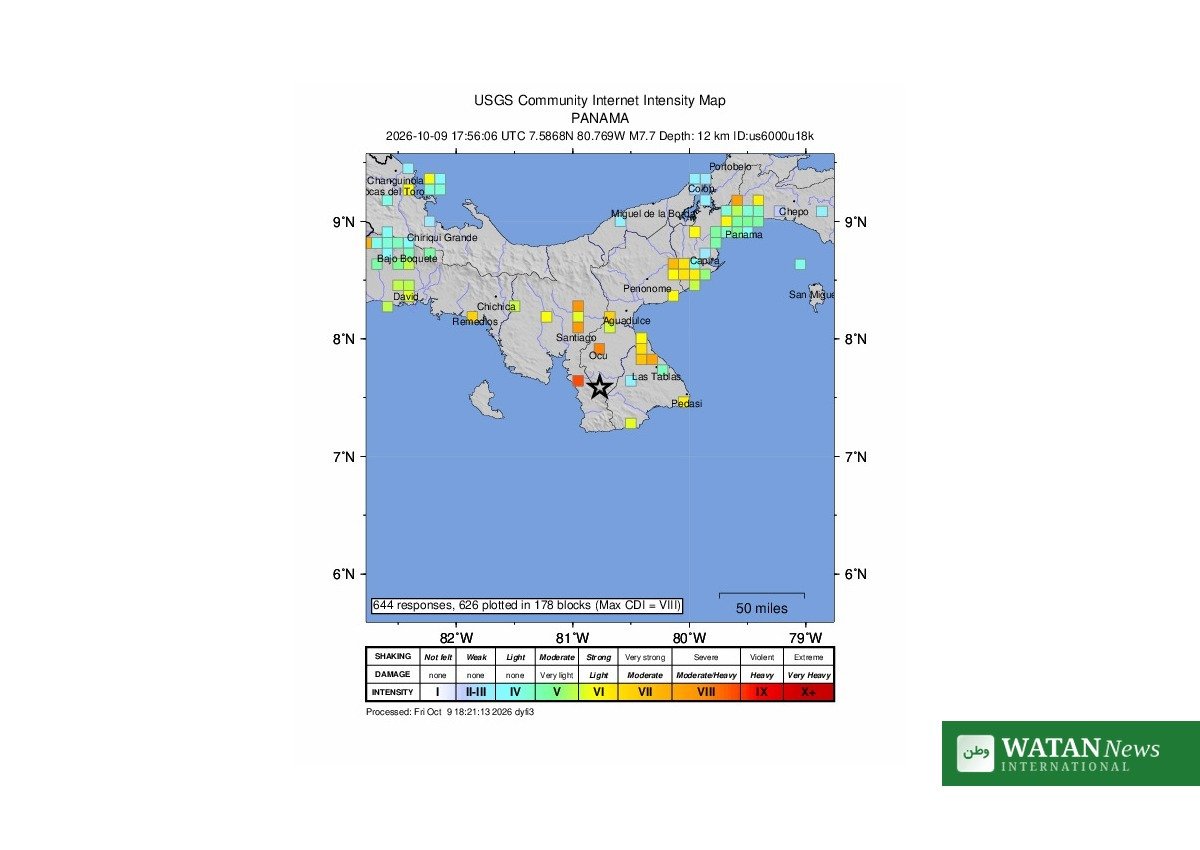
The US Geological Survey said the quake hit at 12:56 p.m. local time (1756 GMT) with its epicenter about 12 kilometers (7.5 miles) west-southwest of Pitaloza Arriba in Herrera province, at a depth of 12.6 kilometers (7.8 miles). It was felt strongly in Panama City, more than 200 kilometers from the epicenter, where office workers evacuated high-rise buildings and traffic ground to a halt.
FAKTA
- A magnitude 7.7 earthquake struck southern Panama on Friday, Oct. 9, 2026, at 12:56 p.m. local time.
- The epicenter was near Pitaloza Arriba in Herrera province, on the Azuero Peninsula; the USGS put the depth at 12.6 km.
- A hotel and several homes collapsed in Tonosi; a government building, a church and the Dos Continentes hotel partially collapsed in Penonome.
- Several people were injured, but no deaths were immediately reported, and the country appeared to have escaped widespread destruction.
- More than 40 aftershocks followed, the largest a magnitude 6.6; a tsunami warning was issued for the Pacific coast but no damaging waves were reported.
- The Panama Canal and the Cobre Panama copper mine reported normal operations; Tocumen International Airport briefly suspended flights for safety checks.
Buildings collapse after the Panama 7.7 earthquake
The worst damage was reported in the southern provinces of Herrera and Los Santos. In Tonosi, a hotel and several homes collapsed. In Penonome, about halfway between the epicenter and Panama City, several buildings collapsed and a church was damaged.
President Raul Mulino traveled to Penonome on Friday to assess the damage. Panama’s civil protection agency said impacts were also reported in Chitre, the capital of Herrera province, and along the coast in Los Santos province.
Several people were injured, including at least one in Penonome, according to Panamanian media. The USGS estimated that about 43,000 Panamanians lived in areas exposed to severe shaking, and said economic losses could amount to between 1% and 10% of Panama’s gross domestic product. Electricity provider Naturgy reported power outages in six provinces.
Tsunami warning issued for the Pacific coast
Shortly after the quake, the US National Weather Service issued a tsunami warning covering Colombia, Ecuador and a significant part of the Central American Pacific coast. The US Pacific Tsunami Warning Center said waves of between 3 and 9 feet were possible along Panama’s coast.
No damaging tsunami was ultimately reported. Costa Rica’s emergency commission ruled out a tsunami threat for its coast, according to local media.
Strong aftershocks rattle the country
More than 40 aftershocks rattled Panama in the hours after the main tremor, according to seismologists at the University of Panama. The largest, a magnitude 6.6, struck at 8:25 p.m. local time (2025 GMT), followed by several tremors above magnitude 5.
Nestor Luque, director of Panama’s geosciences institute, attributed the quake to the Azuero-Sona fault system, saying a massive buildup of pressure along the fault had been released. “The seismic signals have traveled throughout the national territory, and that is why it could be felt everywhere,” he said. Luque said he counted 40 seconds of vibrations in Panama City.
Sabina Rios, who was on the sixth floor of an old US military-era building in Panama City, said: “The quake felt strong and lasted a long time, the longest I’ve felt in years.”
A rare powerful quake for Panama
Strong earthquakes are not common in Panama, and many residents were visibly shaken. “We’re scared. It’s just the two of us old folks here. The house has cracked, and we’re afraid it could fall on us,” 74-year-old Ricardo Brown said in Herrera province.
Victor Pinzon, a 48-year-old maintenance worker in Panama City, said he watched high-rise window cleaners ride out the shaking. “It’s a miracle they didn’t get killed,” he said. “They looked like they were swinging in a hammock.”
The quake came as Panama was preparing to hold a national evacuation drill the following Monday to test the country’s emergency response. It also followed a deadly year of seismic activity in the region: back-to-back earthquakes in Venezuela in June killed several thousand people, while an earthquake in Colombia in August killed more than 300.
The Panama Canal and the Cobre Panama copper mine both reported normal operations after the tremor, and Tocumen International Airport lifted its suspension of flights after completing safety inspections.
For more international news and developing stories, visit Watan News.
Author

usman2344913@gmail.com
Related Posts

SAS Restarts Nonstop Copenhagen–Mumbai Flights After 17 Years
- 0
- 589 words
The new Copenhagen-Mumbai flights have taken off. Scandinavian Airlines (SAS) has relaunched its year-round nonstop service between Copenhagen Airport (CPH) and Mumbai...
Read out all
U.S. Housing Market Cools as 30-Year Mortgage Rate Tops 7%
- 0
- 1,001 word
The U.S. housing market has cooled sharply this fall as the 30-year mortgage rate climbed back above 7%, reaching 7.28% in the...
Read out all
Esbjerg Opens Nominations for 2026 Integration Prize
- 0
- 743 words
Esbjerg Municipality on Denmark's west coast has opened nominations for its 2026 Integration Prize, an annual award honouring people, businesses and associations...
Read out all
Denmark’s 2027 Budget Proposal: Tax Cuts, Free Transport for Under-22s, Defence at 3.5% of GDP
- 0
- 1,324 word
Denmark's government has presented its 2027 budget proposal, the first full finance bill of Prime Minister Mette Frederiksen's four-party coalition, combining tax...
Read out all
Aaron Sorkin’s ‘The Social Reckoning’ Opens in Theatres: Reviews, Cast and Box Office
- 0
- 896 words
Aaron Sorkin has returned to the story of Facebook with The Social Reckoning, the follow-up to his Oscar-winning screenplay The Social Network....
Read out all
US Proposes $70,000 OPT Fee for International Students, Alarming Universities
- 0
- 1,213 word
The United States has proposed a major shake-up of its Optional Practical Training (OPT) programme with a new OPT fee that could...
Read out all