- 0
- 1,076 word
The Ghana forest restoration push took a major step this week as the GH¢35 million reclamation of the galamsey-ravaged Tano Nimri Forest Reserve moved toward completion. Military engineers are finishing the heavy earthworks on the degraded reserve land, and the site is expected to be handed over to the Ghana Forestry Commission in the coming weeks for the reforestation phase.
The Ghana Gold Board (GoldBod) is funding the project, which pairs the Ghana Armed Forces Engineer Regiment’s civil-engineering work with a decade-long afforestation programme. It is the first beneficiary of GoldBod’s national land-reclamation and environmental-restoration programme, and is expected to serve as a pilot for restoring other forests damaged by illegal mining across the country.
Ghana Forest Restoration: GH¢35 Million Reclamation Plan
According to Ghana’s Ministry of Defence, the agreement between GoldBod, the Ghana Armed Forces and the Forestry Commission was signed on 17 June 2026 and took effect on 6 July 2026. The total investment is approximately GH¢35 million, split into two parts:
- GH¢27.9 million for the civil-engineering component, paid to the Ghana Armed Forces Engineer Regiment;
- GH¢7.2 million for the afforestation component, to be undertaken by the Forestry Commission over the next ten years, with GH¢2.2 million allocated for the first phase between 2026 and 2027.
The initial phase focuses on Compartment 161 of the Tano Nimri Forest Reserve in the Western North Region. The Defence Ministry describes the target area as 50 hectares of degraded land out of an estimated 200 hectares damaged in that compartment; some media reports put the immediate reclamation figure at about 60 hectares.
GoldBod CEO Sammy Gyamfi said the reserve was selected as the programme’s first beneficiary because of the extensive degradation it suffered. He explained that partnering with the Armed Forces was a deliberate choice: reclamation projects have in the past been exploited as cover for further illegal mining, so the work needed an institution trusted for its integrity, discipline and reliability.
Damage From Illegal Mining, 2021–2024
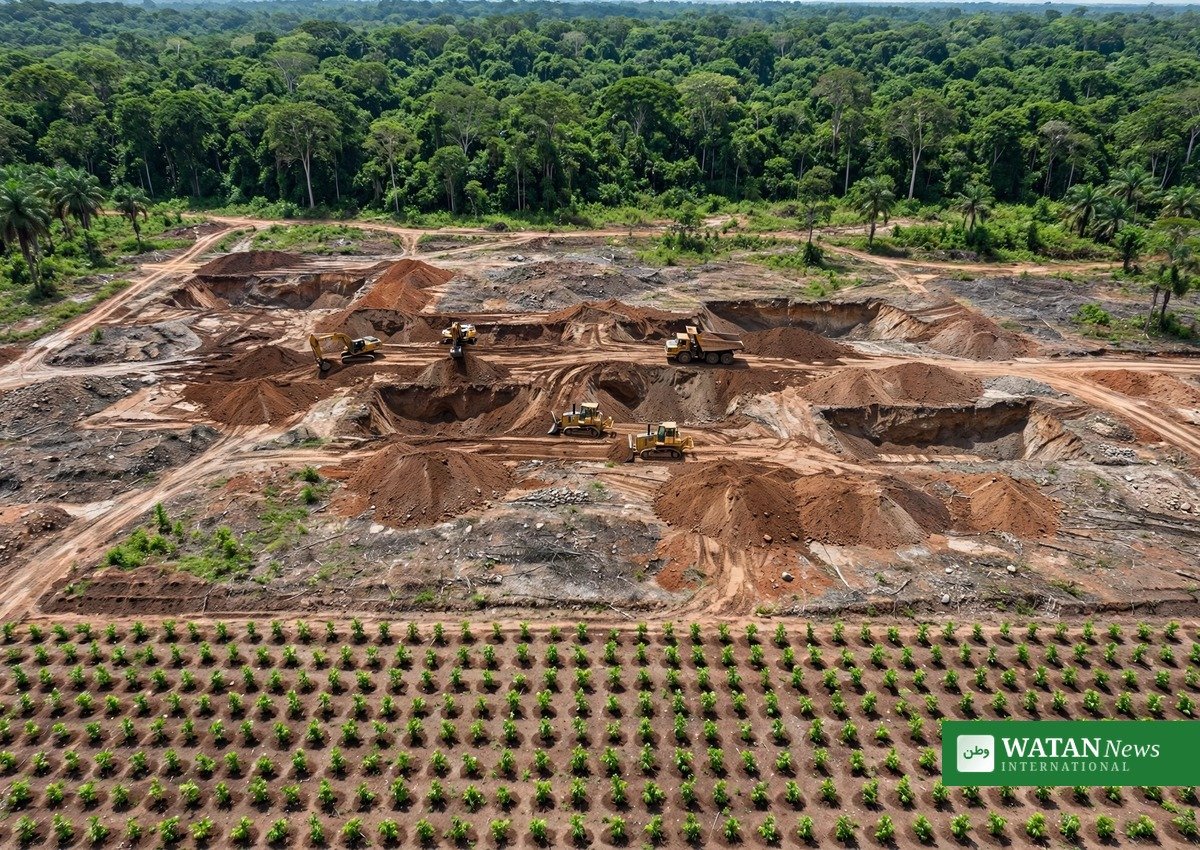
Illegal small-scale gold mining — known locally as galamsey — caused the destruction. Project information indicates that approximately 192.4 hectares of woodland were destroyed between 2021 and 2024, leaving behind deep excavations, unstable terrain and damaged vegetation.
Samuel Danso, Sustainability Manager at Samatex Company Limited, explained that a major invasion by illegal miners in 2022 severely affected the area’s biodiversity and the timber concessions previously managed by the company.
The engineering assessment identified 10 major pits alongside numerous smaller excavations containing large volumes of water. Such pits create dangerous conditions for people and wildlife, and disturbed soil is vulnerable to erosion; runoff can carry sediment into the nearby Tano River, affecting water quality and aquatic habitats.
Engineering First, Then Reforestation
The Ghana Armed Forces Engineer Regiment, under the operational command of Major Shem Adolinama, is carrying out the heavy earthmoving component: filling the dangerous mining pits, reshaping the land, stabilising disturbed soil, and constructing drainage channels to manage surface water and limit sediment entering the Tano River. Engineers have also been blending wet mud with dry soil to improve ground conditions and prepare the site for vegetation.
Simply planting trees would not be enough here. Where the soil structure has been substantially altered and the vegetation removed, the land cannot regenerate naturally — backfilling and grading must come first so the site is safe and stable enough for new growth.
The engineering phase is nearing completion. Once the reclaimed area is handed over to the Forestry Commission, the next phase will involve planting trees and encouraging the regeneration of indigenous plant species.
Why Reforestation Alone Is Not Enough
The success of the project will be measured by the condition of the forest in the years ahead — not only by the number of seedlings planted. Seedling survival, the suitability of the selected species to the site, and protection of young vegetation against further disturbance will all influence the outcome, and long-term monitoring of tree survival, soil stability and water quality will be essential.
Professor Ishmael Quaicoe, Director of Responsible Mining at the United Nations University, has said a further 100 hectares of degraded forest land would be reclaimed next year, with the Tano Nimri project expected to serve as a pilot for future restoration efforts. Forestry Commission Chief Executive Dr Hugh Brown said the project would support biodiversity conservation, watershed protection and the long-term sustainability of forest resources, and appealed to corporate institutions and development partners to support similar initiatives.
Preventing renewed illegal mining will be crucial: if the land stabilises, native vegetation returns and the area remains protected, the project could become a practical model for how Ghana repairs environmental damage while strengthening responsible natural-resource management. For more international climate and restoration reporting, see Watan News English climate coverage.
FAKTA
- Investment: approximately GH¢35 million (GH¢27.9M engineering; GH¢7.2M afforestation over 10 years).
- Location: Compartment 161, Tano Nimri Forest Reserve, Western North Region, Ghana.
- Damage: about 192.4 hectares of woodland destroyed by illegal mining between 2021 and 2024.
- Partners: Ghana Gold Board (funder), Ghana Armed Forces Engineer Regiment (engineering), Forestry Commission (reforestation).
- Agreement: signed 17 June 2026, effective 6 July 2026; engineering works nearing completion; handover for tree planting expected in the coming weeks.
Frequently Asked Questions
What is galamsey?
Galamsey is the local term for illegal small-scale gold mining in Ghana. Beyond the Tano Nimri case, it is widely reported to destroy forests, pollute rivers and water bodies, and damage farmland across the country.
What is GoldBod?
The Ghana Gold Board (GoldBod) is a Ghanaian government agency. In this project it provides the funding and supervisory oversight, while the military handles engineering and the Forestry Commission handles the planting phase. Its CEO is Sammy Gyamfi.
How is the GH¢35 million being spent?
According to Ghana’s Ministry of Defence: GH¢27.9 million goes to the Ghana Armed Forces Engineer Regiment for civil engineering (pit-filling, land reshaping, drainage), and GH¢7.2 million goes to the Forestry Commission for afforestation over ten years, with GH¢2.2 million earmarked for the first phase in 2026–2027.
When will trees actually be planted?
Tree planting begins after the engineering phase. The works are nearing completion, and the site is expected to be handed over to the Forestry Commission in the coming weeks. The Commission will then lead planting and the regeneration of indigenous vegetation.
Will more damaged forests be restored?
The Tano Nimri project is designed as a pilot for GoldBod’s national reclamation programme. Professor Ishmael Quaicoe of the United Nations University has said a further 100 hectares of degraded forest land would be reclaimed next year, and the Forestry Commission is appealing for corporate and development partners to back similar efforts.
Author

usman2344913@gmail.com
Related Posts
Israeli Drone Strikes Kill Six Across Gaza Despite Ceasefire
- 0
- 517 words
Gaza drone strikes killed six Palestinians across the Gaza Strip on Saturday, medical workers say, despite a year-old ceasefire — as UNICEF...
Read out all
Ghana skovrestaurering: 35 mio. cedi skal genoprette ulovlig minedrift-ødelagt reservat
- 0
- 1,053 word
Ghana skovrestaurering tog i denne uge et stort skridt fremad, da genopretningen af det galamsey-hærgede Tano Nimri-skovreservat for 35 millioner cedi nærmede...
Read out all
گھانا جنگلاتی بحالی: غیر قانونی کان کنی سے تباہ شدہ جنگلاتی ذخیرے کی بحالی کے لیے 35 ملین سیڈیز کا منصوبہ
غیر قانونی کان کنی سے تباہ شدہ ٹانو نمری جنگلاتی ذخیرے کی گھانا جنگلاتی بحالی اس ہفتے ایک اہم مرحلے میں داخل...
Read out all
Ellev lande mødtes i Jakarta for at rykke den globale plastiktraktat frem
- 0
- 1,511 word
Jakarta plastiktraktat-forhandlingerne fik ny fremdrift i denne uge, da Indonesien og Norge samlede delegerede fra 11 lande i den indonesiske hovedstad til...
Read out all
جاکارتہ میں گیارہ ممالک کا مشاورتی اجلاس، عالمی پلاسٹک معاہدے کو نئی رفتار ملی
- 0
- 6 words
جاکارتہ پلاسٹک معاہدہ کے عمل کو اس ہفتے نئی رفتار ملی جب انڈونیشیا اور ناروے نے انڈونیشیا کے دارالحکومت میں گیارہ ممالک...
Read out all
Eleven Countries Meet in Jakarta to Push the Global Plastics Treaty Forward
- 0
- 1,450 word
The Jakarta plastics treaty process gained new momentum this week as Indonesia and Norway convened delegates from 11 countries in the Indonesian...
Read out all