- 0
- 744 words
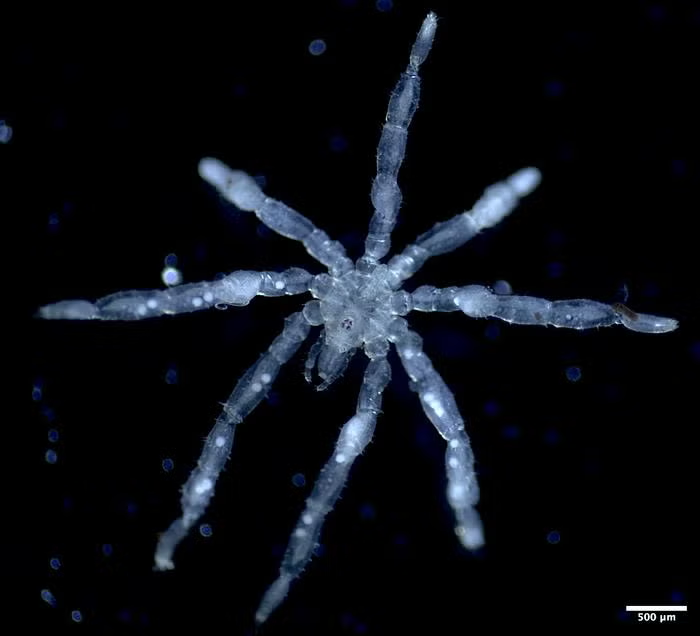
Scientists have identified two previously unknown species of sea spiders along the Canadian coastline. These marine arthropods, discovered in the Salish Sea, represent the first new sea spider species found in the region in over a century.
- Two new species of sea spiders were discovered off the coast of British Columbia, Canada.
- The discoveries were made in the Salish Sea, between Washington State and British Columbia.
- These are the first new sea spider species identified in the area in more than 100 years.
- The newly found species measure approximately one centimeter across.
Marine Arthropod Discoveries
Researchers from the University of British Columbia have announced the discovery of two novel sea spider species. These findings add to the more than 1,300 known species of sea spiders globally.
The sea spiders were collected during expeditions conducted between September 2023 and August 2024.
- The discoveries were made by a team led by Cormac Toler-Scott at the University of British Columbia.
- Sea spiders belong to the class Pycnogonida and are marine arthropods.
- Over 1,300 species of sea spiders have been identified worldwide.
- The new species were found in shallow waters of the Salish Sea.
Habitat and Characteristics
The newly identified sea spiders inhabit the shallow waters of the Salish Sea, a marine environment situated between Washington State in the U.S. and the Canadian province of British Columbia.
These creatures are distinct from their terrestrial spider relatives, being entirely aquatic and slow-moving, typically found crawling along the seafloor.
Species Identification and Naming
One of the newly discovered species has been named Callipallene pilosuspedes . This species is characterized by its red eyes, a triangular, three-lipped mouth, and a curved spine adorning its legs.
It also possesses specialized limbs called ovigers, which are used for grooming and removing debris.
- Callipallene pilosuspedes features red eyes and a distinctive mouth shape.
- Ovigers, limb-like appendages, are used for self-grooming in this species.
- The species is noted for its cleanliness, a trait not universal among sea spiders.
The second new species is named Tanystylum kiixin . This name honors an ancient Indigenous village located near the discovery site.
Tanystylum kiixin has shorter, more robust legs extending from its chest, which are not used for cleaning. Researchers observed this species covered in dirt and debris upon discovery.
Unique Adaptations
The ovigers on Callipallene pilosuspedes are particularly noteworthy for their grooming function, distinguishing it from many other sea spider species. This ability to maintain cleanliness is a significant characteristic noted by the research team.
Reproduction and Diet
Sea spiders exhibit unique reproductive strategies compared to land spiders. While females develop the eggs, the males undertake the crucial role of carrying and protecting them until hatching.
Their feeding habits also differ significantly; they do not construct webs to catch prey.
- Female sea spiders produce eggs.
- Male sea spiders are responsible for egg care and protection.
- Eggs are carried by males until they hatch.
- Sea spiders do not spin webs to hunt.
The newly discovered species were found attached to hydroids, which are marine animals that often resemble plants and live in colonial formations. This suggests a specific ecological niche and feeding relationship for these sea spiders.
Ecological Significance
The discovery of Tanystylum kiixin and Callipallene pilosuspedes highlights the ongoing potential for new species identification even in relatively well-studied marine areas. The Salish Sea, a biologically rich environment, continues to yield scientific insights.
Further Research Avenues
These findings underscore the importance of marine biodiversity research and conservation efforts. Understanding the specific habitats and ecological roles of newly discovered species is crucial for protecting these delicate marine ecosystems.
Conclusion
The identification of two new sea spider species, Callipallene pilosuspedes and Tanystylum kiixin , marks a significant contribution to marine biology. Found in the Salish Sea off the Canadian coast, these discoveries emphasize the vastness of unexplored marine life.
Researchers are continuing to study their unique characteristics, reproductive behaviors, and ecological roles within their habitat. These findings reinforce the need for continued exploration and conservation of our planet’s oceans.
Frequently Asked Questions
What are sea spiders?
Sea spiders are marine arthropods belonging to the class Pycnogonida, known for their eight legs and distinct appearance.
Where were the new species found?
The two new species were discovered in the shallow waters of the Salish Sea, along the Canadian coastline.
How do sea spiders reproduce?
Females produce eggs, but males carry and care for them until they hatch.
Are sea spiders related to land spiders?
Yes, sea spiders are related to land spiders but are exclusively marine creatures.
Author

usmanjaved13132@gmail.com
Related Posts
AI in Schools: ‘Wild West’ Lacks Research Amid Abundant Experiments
- 0
- 804 words
Schools across the United States are rapidly experimenting with artificial intelligence, despite a significant lack of research into its effectiveness and potential...
Read out all
Mbappe-less France Faces Belgium in Nations League Showdown
- 0
- 898 words
France will face Belgium in a highly anticipated UEFA Nations League clash on Monday, September 28, 2026, at the King Baudouin Stadium...
Read out all
Avanti West Coast Rail Services to be Renationalised in March
- 0
- 745 words
The UK government has announced that Avanti West Coast rail services will be renationalised in March, marking a significant shift in public...
Read out all
UK Chancellor John Healey Vows ‘New Age of Industrialisation’ Amid Defence Spending Debate
- 0
- 867 words
Chancellor John Healey is set to deliver a significant speech at the Labour conference, promising a “new age of industrialisation” for Britain....
Read out all
Qatar-origin flight landed at Sialkot airport, not in IIOJK, clarifies official
- 0
- 653 words
Sialkot International Airport has officially clarified reports suggesting a Qatar Airways flight from Doha landed in Indian Illegally Occupied Jammu and Kashmir...
Read out all
Australia Grapples with Rising Fuel Costs and Looming Interest Rate Hike
- 0
- 840 words
Australia is facing a dual economic challenge as petrol prices surge and the Reserve Bank of Australia (RBA) is widely expected to...
Read out all