- 0
- 1,921 word
Antalya, Türkiye — COP31’s closing plenary was suspended until Saturday morning after countries deadlocked over a draft agreement that drops every mention of fossil fuels, strips out health protections and removes a $120 billion adaptation target. The 6pm Friday deadline came and went with no deal, and a third revision of the text is promised for Saturday — though delegates huddling in the halls on Friday evening held little hope it would restore the missing words.
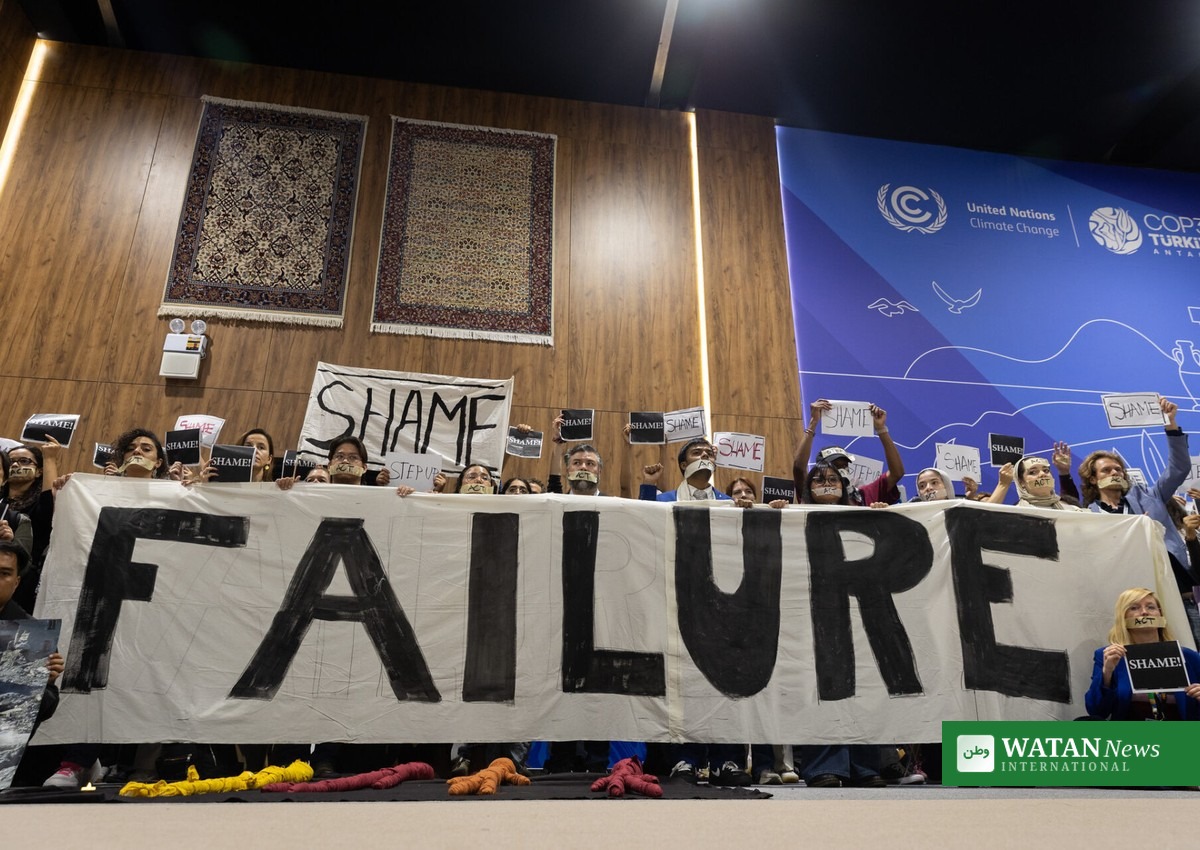
The suspension caps a final day defined by protest as much as by negotiation. Civil society delegates opened the closing plenary holding a banner reading “FAILURE” and black signs reading “SHAME”, while the Alliance of Small Island States warned that COP31 would be a failure if it did not respond to what it called “out of control warming”. Watan News reported on Friday how the world’s press covered the closing day, and how Thursday’s draft dropped every fossil-fuel reference.
Key facts
- The closing plenary opened on Friday 20 November and was suspended until Saturday morning; the summit passed its 6pm deadline with no deal adopted.
- The second draft cover decision, released on Thursday afternoon, runs to nine pages — half the first version — and contains no mention of coal, oil or gas.
- The draft drops a $120 billion annual adaptation finance target for developing countries. It still backs tripling adaptation finance by 2035 but names no dollar figure, while putting adaptation needs at $305 billion a year.
- The standalone health paragraph that named malaria, dengue and cholera now names no diseases at all.
- The hosts’ 35-by-35 electrification goal — raising electricity’s share of final energy use from about 23% to 35% by 2035 — survives only as an option for “global cooperation”, not as a call on countries.
- Australia’s Climate Minister Chris Bowen, who is steering the negotiations, said: “We won’t be leaving the rooms of Antalya until we have that consensus.”
What happened on Friday
Negotiators from nearly 200 countries spent two weeks in Antalya trying to agree the summit’s main political decision, known as the cover decision. By Friday, the final scheduled day, the tracks on finance, adaptation and a just transition were still unresolved, and the closing plenary opened against a backdrop of open disagreement over Thursday’s second draft.
The session was later suspended until Saturday morning, with a third revision of the draft promised for Saturday. Mr Bowen pledged to keep working through the night: “People have strong views, of course. I am not stepping away from that. But no one has said to me, let’s give up and go home.” He added that he would keep working “for as long as it takes, to get the job done”.
UN climate chief Simon Stiell told reporters the days ahead were crucial for climate cooperation: “Almost 200 Parties own this process. These are crucial days ahead for climate cooperation, and we have no time to lose.”
COP decisions need consensus, so even one country can block a deal. Panama has threatened to do so unless its demands, including a cap on oil production, are met. Its Environment Minister, Juan Carlos Navarro, wrote to the two COP31 presidents: “They are beautiful speeches. But while we listen to endless oratory, the planet is being destroyed.”
What the second draft cut
The second draft halves the first version to nine pages. What it removes matters more than what it keeps.
Fossil fuels
The first draft, released on Monday, urged countries to speed up “transitioning away from fossil fuels in energy systems” — the wording nearly 200 countries agreed at COP28 in Dubai in 2023. The revised text speaks only of an “irreversible global transition towards low greenhouse gas emissions and climate resilience”. A sentence welcoming Brazil’s roadmap for transitioning away from fossil fuels is gone, along with a call to phase out inefficient fossil fuel subsidies.
COP31 President Murat Kurum, Türkiye’s Environment Minister, said there was no need to repeat fossil fuel language agreed at past summits. “I don’t think there’s any backsliding,” he said.
Adaptation money
The draft drops the $120 billion target to help developing countries adapt to the accelerating impacts of the climate crisis. It still backs efforts to “at least triple adaptation finance by 2035”, but sets no number and instead sets up an “Antalya-to-Addis Ababa Roadmap” that pushes the details to next year’s summit in Ethiopia. The text itself puts adaptation finance needs at $305 billion a year.
“We didn’t come here to beg,” said Zanetor Agyeman-Rawlings, who chairs the African Group of Negotiators. “We came here to claim what is rightfully ours for our people who are suffering the brunt of anthropogenic activities of developed countries.”
Health
The standalone health paragraph, once seen as a possible symbolic win for advocates, named malaria, dengue and cholera among the ways warming already makes people sick. It now names no diseases at all. The surviving mentions of health appear in just one sentence, referring to “physical and mental health” and “climate-resilient health systems”. References to the health co-benefits of cutting emissions were also stripped, and the draft’s single reference to air pollution — linked to 7.9 million deaths in 2023, according to the Health Effects Institute — has been cut. On methane, the draft now calls only for “reductions”, where the first draft wanted them “rapid and substantial”. Food and agriculture go unmentioned.
Carbon capture and electrification
The draft calls for “accelerating” carbon capture and storage, a technology that today captures less than 0.2% of fossil fuel emissions, according to Carbon Brief. The World Resources Institute’s David Waskow noted that the only numerical targets left in the text are the electrification pledge and a capture goal of at least 500 million tonnes of CO2 a year by 2035. Carbon capture backers registered a record 700 delegates at the summit, according to the Center for International Environmental Law.
The hosts’ goal of raising electricity’s share of global energy use from about 23% to 35% by 2035 survives, but it is no longer a call on countries. It now sits on a list of options for “global cooperation”, with a note that countries “will take different pathways”. The first draft’s call for “clean electrification” is gone — a change that matters because, as written, the extra electricity could come from coal or gas as well as from clean sources.
Who is pushing back
The Alliance of Small Island States said in a statement on Friday that COP31 would be a failure if it did not respond to “out of control warming”, calling the overshoot of the 1.5°C limit “an unacceptable consequence of the advancement of profit over people” and saying the bloc “will not acquiesce to further inaction at this COP”.
Mohamed Adow, director of Power Shift Africa, was blunt: “If this version of the text remains, it will be a ghost COP. The summit will have nothing to show for what happened here.” He added that in 15 years of following the negotiations, he had not attended a worse COP than this one.
France and Panama led ten countries in a press conference on Friday demanding six priorities, including an explicit transition away from fossil fuels, fair climate finance, clean electrification from renewable sources and faster methane cuts. Germany’s Environment Minister, Carsten Schneider, told reporters: “There are some that don’t want that we use the words fossil fuels at this COP. There are some who earn a lot of money with that.”
Civil society groups accused formerly “high-ambition” countries in the EU, as well as Norway, the United Kingdom, Japan, Canada and Australia, of giving way on fossil fuels and on a just transition mechanism. “This process is completely unbalanced and unfair,” said Sinéad Magner of the Women’s Environment and Development Organization. “That is an abject failure of the presidencies. Your job is to act as an honest broker.”
The wider picture
The deadlock sits against stark numbers. The Loss and Damage Fund, established at COP28 in 2023, faces $2.8 billion in requests against $486 million received, plus a €25 million pledge from the European Union at this year’s COP. Meanwhile, the leaders of the United States, Russia and China pledged at a summit in Shenzhen this week to “increase the production and supply of refined petroleum products for the benefit of all nations” — a pledge the EU’s climate commissioner, Wopke Hoekstra, called “part of the reality of the climate crisis that we as negotiators have to deal with”.
No COP has finished on time since 2003, according to Carbon Brief, and the longest summit to date finished 44 hours after its scheduled end in Madrid in 2019. Carbon Brief’s sweepstake on when the Antalya summit will end put the median expected finish at 10:35pm on Sunday. Mr Bowen also noted that COP31 would be the first climate summit to acknowledge that the world will fail to hold warming to the 1.5°C limit set out in the Paris Agreement — while insisting it should be remembered for deciding that any overshoot must be kept as small and as short as possible.
What happens next
All eyes are now on the third revision, promised for Saturday morning when the plenary resumes. If it stays as written, COP31 will be the second summit in a row whose main decision fails to name the fuels behind nearly 90% of the world’s carbon dioxide emissions. Delegates worked through Friday night, and the question for Saturday is whether the presidency can find wording that the countries demanding fossil-fuel language — and the countries resisting it — can both accept.
Until the plenary resumes, the summit’s outcome remains unwritten: a deal that restores the missing words, a weaker text adopted for the sake of consensus, or a summit that ends with no agreement at all.
Frequently asked questions
Why was COP31 suspended?
The closing plenary opened on Friday 20 November but was suspended until Saturday morning because countries were sharply divided over the second draft of the cover decision, which drops every mention of fossil fuels, health protections and a $120 billion adaptation target. The summit passed its 6pm Friday deadline with no deal adopted.
What did the second draft remove?
Compared with Monday’s first draft, the nine-page second draft removes all references to fossil fuels, the $120 billion annual adaptation finance target, the diseases named in the health paragraph (malaria, dengue and cholera), the single air-pollution reference, and the call to phase out inefficient fossil fuel subsidies. It also turns the 35-by-35 electrification goal into an option rather than a call on countries.
What is the 35-by-35 goal?
It is the COP31 Presidency’s goal of raising electricity’s share of global final energy use from about 23% to 35% by 2035. In the second draft it survives only as an option for “global cooperation”, with countries free to take “different pathways” — and the call for “clean electrification” was removed, so the extra electricity could come from coal or gas as well as clean sources.
What happens if the third draft also drops fossil fuels?
If the text stays as written, COP31 will be the second summit in a row whose main decision fails to name the fuels behind nearly 90% of the world’s carbon dioxide emissions. Small island states have said such an outcome would make COP31 a failure, and Panama has threatened to block any agreement without fossil-fuel language, since COP decisions need consensus.
When will COP31 actually end?
No COP has finished on time since 2003. The plenary resumes on Saturday morning with a third draft promised, and Carbon Brief’s sweepstake put the median expected finish at 10:35pm on Sunday — 28 hours after the scheduled close.
Author

usmanch0013@gmail.com
Related Posts

کھیل ضائع نہ کریں: ایل اے 28 کو پہلا ایک بار استعمال ہونے والے پلاسٹک سے پاک اولمپکس بنانے کی مہم شروع
75 سے زائد تنظیموں نے 'کھیل ضائع نہ کریں' مہم شروع کی ہے، جس میں ایل اے 28 کے منتظمین اور لاس...
Read out all
Spild ikke legene: Kampagne vil gøre LA28 til de første OL uden engangsplastik
- 0
- 1,469 word
Mere end 75 organisationer har lanceret 'Spild ikke legene', en kampagne der opfordrer LA28's arrangører og Los Angeles' ledere til at gøre...
Read out all
Don’t Waste the Games: Campaign Launches to Make LA28 the First Single-Use Plastic-Free Olympics
- 0
- 1,458 word
More than 75 organisations have launched 'Don't Waste the Games', a campaign calling on LA28 organisers and Los Angeles leaders to make...
Read out all
COP31 udsat til lørdag: Udkast uden fossile brændstoffer, sundhed eller 120 milliarder dollar venter på tredje omskrivning
- 0
- 2,043 words
COP31's afsluttende plenarmøde i Antalya blev udsat til lørdag morgen, da landene ikke kunne blive enige om et udkast, der dropper enhver...
Read out all
کاپ31 ہفتے تک معطل: حیاتیاتی ایندھن، صحت اور 120 ارب ڈالر کے بغیر مسودے کی تیسری نظرثانی متوقع
- 0
- 3 words
انطالیہ میں کاپ31 کا اختتامی اجلاس ہفتے کی صبح تک معطل کر دیا گیا، کیونکہ ممالک ایک ایسے مسودے پر متفق نہ...
Read out all
Houthis Threaten Saudi Red Sea Ports as Coalition Strikes Hodeidah
- 0
- 690 words
Yemen's Houthis threatened Saudi Arabia's Red Sea ports and warned airlines to stay out of Saudi airspace on Friday, after the Saudi-led...
Read out all