- 0
- 1,008 word
The Netherlands and Amsterdam’s Schiphol airport are setting up a €90 million fund to push airlines to use more sustainable aviation fuel (SAF) than EU law requires, in a green-travel package announced this week that also caps the country’s planned long-haul flight tax at €59.43 per passenger for 2027.
The move comes as new official data shows Europe’s first binding green-fuel rules are already working: the EU Aviation Safety Agency (EASA) reported in September that fuel suppliers delivered 1.1 million tonnes of SAF at EU airports in 2025 — 2.8 percent of all aviation fuel, beating the 2 percent minimum set by the ReFuelEU Aviation mandate.
A €90 million fund for fuel above the mandate
The Dutch government is working with Schiphol to establish the fund to accelerate the adoption of SAF between 2027 and 2029, according to reports on the announcement published this week. Travel trade coverage of the announcement puts the planned split at €45 million from the Dutch government and a matching €45 million from Schiphol, with the fund still subject to approval by the European Commission.
Crucially, the money targets SAF use beyond the mandatory baseline. ReFuelEU Aviation already requires fuel suppliers at covered EU airports to meet a minimum 2 percent SAF share from 2025, rising to 6 percent in 2030 and eventually 70 percent by 2050. The Dutch incentive aims at consumption above that regulatory floor.
The scale reflects the core problem: according to Schiphol’s own sustainability reporting, sustainable aviation fuel currently costs almost three times as much as conventional kerosene and remains limited in availability. Schiphol’s previous SAF incentive programme, which ran from 2022 to 2024, helped participating airlines use more than 40,000 tonnes of the fuel — a pilot the new fund is designed to dwarf.
Reports also point to a further €300 million in Dutch government support for scaling up SAF production itself, including next-generation e-SAF and advanced bio-SAF, with the first subsidy decisions expected in 2027.
Long-haul tax capped in the same package
Alongside the fund, the government has scaled back a planned rise in aviation tax on long-haul flights to €59.43 per passenger in 2027, matching the rate in neighbouring Germany. The levy on flights of more than 5,500 kilometres had been due to rise to €74.81 per passenger.
Dutch aviation taxes are due to move to a new three-tier system depending on flight length from January 2027, according to the reports: €31.04 per passenger for flights of less than 2,000 kilometres and €49.87 for flights of between 2,000 and 5,500 kilometres.
KLM welcomed the long-haul move but called for taxes on shorter services to also be aligned with Germany, where rates are €13.03 and €33.01 respectively. A KLM spokesperson said the Netherlands remains considerably more expensive than many European countries, warning that the risk of passengers shifting to airports across the border remains.
Schiphol said in a statement that it supported the government’s decision, describing the Netherlands as a small country with a strong aviation sector that has developed into an international hub supporting businesses, jobs and opportunities. The airport said protecting that position requires predictable government policy and a level playing field within Europe.
Europe’s SAF supply already beats the 2025 target
The Dutch package lands against encouraging continent-wide numbers. EASA’s 2026 ReFuelEU Aviation Annual Technical Report, published in Cologne on 17 September 2026, found that aviation fuel suppliers delivered 39.3 million tonnes of fuel at EU airports in 2025, of which 1.1 million tonnes — 2.8 percent — was sustainable aviation fuel.
That is nearly six times the 193,000 tonnes supplied in 2024, before the mandate took effect. SAF was supplied at 121 airports across all 27 EU member states — 79 percent of the bloc’s airports, up from 33 airports in 2024 — and EASA calculates that using SAF instead of conventional jet fuel avoided 3.77 million tonnes of greenhouse-gas emissions in 2025.
“We are pleased to confirm that the SAF mandate under ReFuelEU Aviation was not only met but exceeded,” said Florian Guillermet, EASA’s executive director. “Through our monitoring work, EASA is building a strong evidence base to track this progress, understand how the European SAF market is developing and identify where further action may be needed to support the next stages of the transition.”
EASA projects that EU SAF production capacity remains on track to meet the overall 6 percent blending target by 2030.
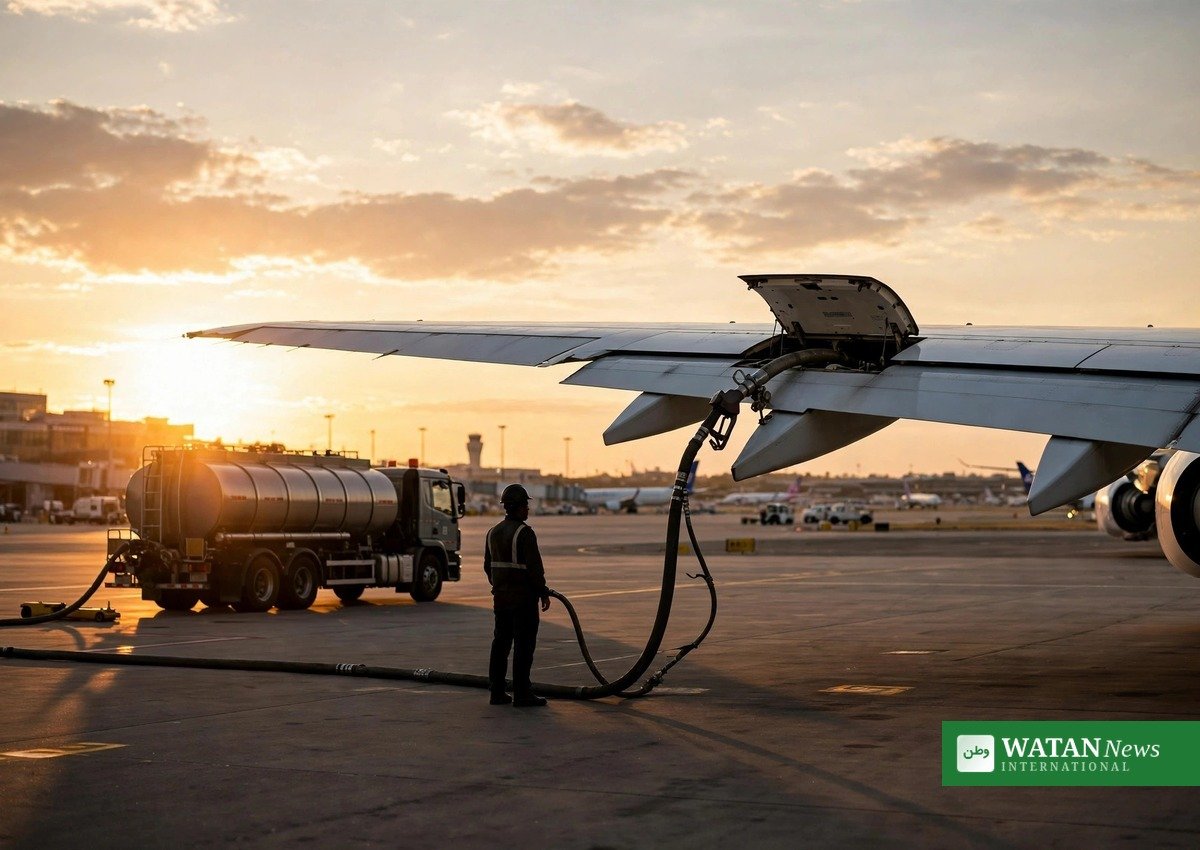
A fuel tanker and crew refuel an aircraft at sunset. Sustainable aviation fuel currently costs almost three times as much as conventional kerosene — which is why the Netherlands is stepping in with subsidies.
Singapore’s SAF levy took effect this month
The Netherlands is not acting alone. In Singapore, a new SAF levy took effect on 1 October 2026, according to the Civil Aviation Authority of Singapore (CAAS). The levy applies to origin–destination passengers and cargo on flights departing Singapore, for tickets or services sold from 1 April 2026.
The amount is set based on the volume of SAF needed to meet Singapore’s 1 percent SAF target for 2026 and the projected price premium of SAF over conventional jet fuel. Economy-class passengers pay S$1.00 on flights to Bangkok, S$2.80 to Tokyo, S$6.40 to London and S$10.40 to New York.
Together, the Dutch fund, Singapore’s levy and the EU mandate show green air travel entering a new phase: no longer just pledges for 2050, but real money and real charges changing the economics of flying now. For travellers who want the lowest-carbon option, rail remains the benchmark — and new EU rules mean the “eco-friendly” claims they see on booking sites must now be proven or removed.
Key facts
- The Dutch government and Schiphol are establishing a €90 million fund for 2027–2029 to drive SAF use above the EU mandate, subject to European Commission approval.
- A further €300 million in Dutch support is planned for SAF production scale-up, including e-SAF and advanced bio-SAF; first subsidy decisions are expected in 2027.
- ReFuelEU Aviation requires a 2 percent SAF share from 2025, rising to 6 percent in 2030 and 70 percent by 2050.
- EASA reports 1.1 million tonnes of SAF (2.8 percent) were supplied at EU airports in 2025 — beating the 2 percent mandate and avoiding 3.77 million tonnes of emissions.
- Dutch long-haul flight tax is capped at €59.43 per passenger in 2027, matching Germany; a new three-tier aviation tax starts in January 2027.
- Singapore’s SAF levy applies to flights departing from 1 October 2026: S$1 to S$10.40 per economy passenger depending on distance.
Author

usman2344913@gmail.com
Related Posts
Nederlandene sætter 90 millioner euro bag grønnere flyvning, mens Europas SAF-forsyning slår sit første mål
- 0
- 1,047 word
Nederlandene og Schiphol opretter en fond på 90 millioner euro til at fremskynde brugen af bæredygtigt flybrændstof fra 2027, sideløbende med en...
Read out all
یورپ میں پائیدار ہوائی ایندھن کی فراہمی بڑھنے پر نیدرلینڈز کا فضائی سفر کو ماحول دوست بنانے کے لیے 90 ملین یورو کا منصوبہ
نیدرلینڈز اور اسکیفول ہوائی اڈے کی جانب سے 2027 سے 2029 تک 90 ملین یورو کے پائیدار ہوائی ایندھن فنڈ کا اعلان،...
Read out all
Karachi garment factory fire extinguished after 4-hour battle
- 0
- 804 words
A major fire at a garment factory near Habib Bank Chowrangi in Karachi's SITE area was extinguished early Monday after a four-hour...
Read out all
Sådan køler træplantning byer og bremser oversvømmelser: Klimavidenskaben bag den globale plantningsbølge
- 0
- 864 words
Forklarende artikel: gadetræer kan sænke lufttemperaturen med op til 4°C, og et fuldvoksent træ opfanger 15.000 liter regnvand om året — den...
Read out all
شجر کاری شہروں کو کیسے ٹھنڈا رکھتی اور سیلاب سے کیسے بچاتی ہے: عالمی شجر کاری مہمات کے پیچھے موسمیاتی سائنس
معلوماتی مضمون: شہر کی سڑکوں پر درخت درجہ حرارت 4 ڈگری سینٹی گریڈ تک کم کر سکتے ہیں اور ایک بالغ درخت...
Read out all
How Tree Planting Cools Cities and Holds Back Floods: The Climate Science Behind the Global Plantation Push
- 0
- 861 words
Explainer: trees on city streets can cut air temperatures by up to 4°C and one mature tree intercepts 15,000 litres of rainwater...
Read out all