- 0
- 1,205 word
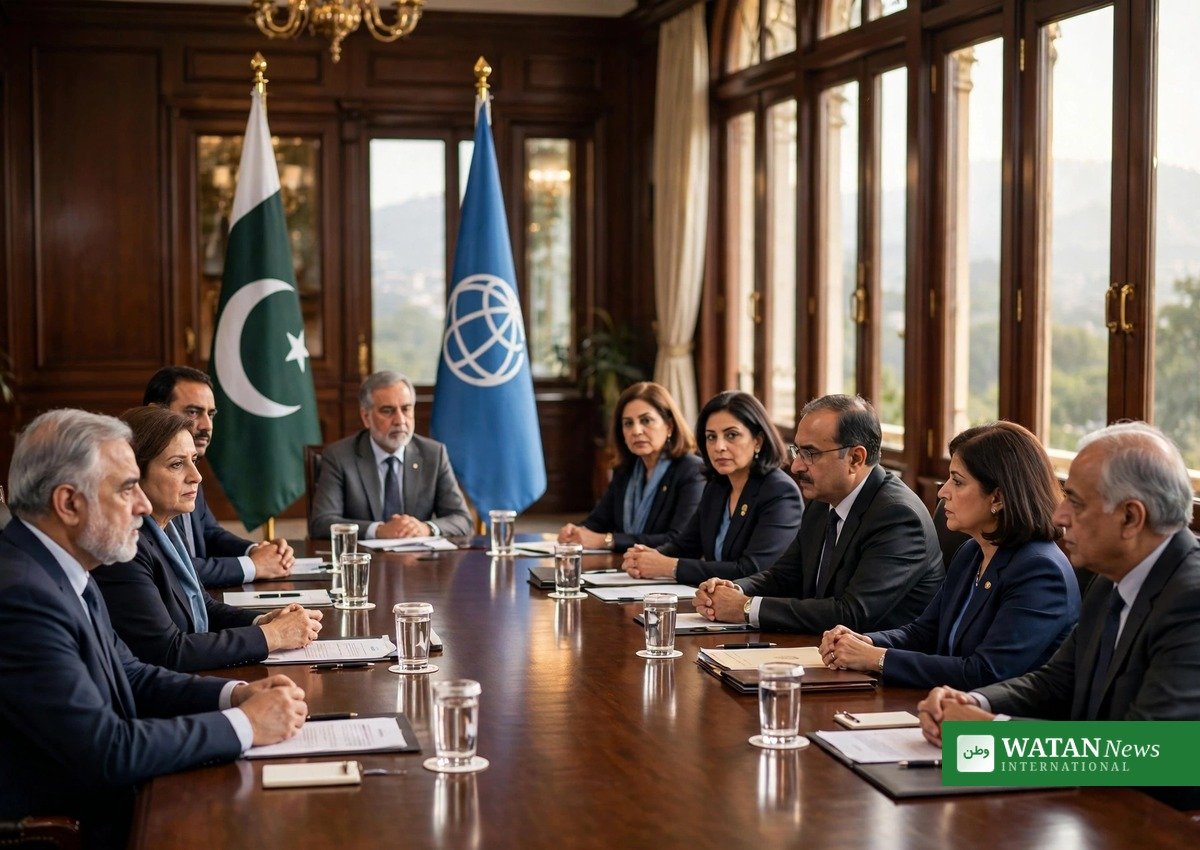
Federal Minister for Finance and Revenue Senator Muhammad Aurangzeb met a World Bank delegation led by Country Director Bolormaa Amgaabazar at the Finance Division in Islamabad on Friday, reviewing progress under Pakistan’s ongoing economic reform partnership and setting implementation priorities across growth, jobs, fiscal management and investment. The Pakistan World Bank economic strategy meeting focused on turning agreed reform designs into concrete, measurable actions — a shift both sides described as the partnership’s central challenge.
FAKTA: Key Facts at a Glance
- Federal Finance Minister Muhammad Aurangzeb met a World Bank delegation led by Country Director Bolormaa Amgaabazar in Islamabad on Friday, 2 October 2026.
- The meeting reviewed Pakistan’s broader economic reform partnership, covering growth, jobs, fiscal management, revenue mobilization, capital-market development, trade and investment, and institutional reforms.
- Aurangzeb stressed moving from reform design to effective implementation, with a focus on measurable gains in economic activity, investment, jobs and the business environment.
- Both sides discussed a proposed World Bank growth and jobs operation: better investment climate, SME access to finance, export-finance products for the EXIM Bank of Pakistan, and reduced regulatory constraints.
- Fiscal and revenue reforms on the agenda included the Medium-Term Revenue Strategy, GST harmonization, agricultural income tax implementation, provincial property-tax reforms and tax-policy capacity building.
- Capital markets, debt management, sovereign credit ratings and public-sector rightsizing were also reviewed, alongside skills development and overseas migration pathways.
- Both sides reaffirmed their commitment to continued cooperation, with implementation and institutional strengthening as the shared focus.
Reform Implementation, Not Just Reform Design
Aurangzeb underscored that Pakistan’s reform agenda must now move decisively from design to delivery. According to the meeting’s account reported by The Standard, the emphasis was on practical measures capable of delivering measurable improvements in economic activity, investment, jobs and the overall business environment — and on stronger coordination between federal ministries, provincial governments and implementing agencies.
The meeting reviewed the World Bank’s support for Pakistan’s broader economic reform agenda, with particular weight on translating priorities into targeted, implementable actions rather than broad declarations.
Pakistan World Bank Economic Strategy: The Growth and Jobs Operation
A major item on the table was the proposed World Bank growth and jobs operation, including interventions aimed at improving the investment climate, access to finance, sectoral productivity and labor-market outcomes. The lender outlined proposed measures relating to the investment framework, reduction of regulatory and business constraints, access to finance for SMEs, and development of export-finance products for the EXIM Bank of Pakistan to support incremental trade flows.
The discussion also covered reforms to strengthen the Prime Minister’s Access to Finance initiative, including a unified insolvency framework, factoring legislation and regulations to support SME financing, as well as measures to expand commercial financing and greater private-sector participation.
| Reform area | What was discussed |
|---|---|
| Investment climate | Investment framework, fewer regulatory and business constraints |
| SME finance | Better access to finance, unified insolvency framework, factoring legislation |
| Trade | Export-finance products for EXIM Bank of Pakistan, tariff policy implementation |
| Revenue | Medium-Term Revenue Strategy, GST harmonization, agricultural income tax, property-tax reform |
| Capital markets | Reform roadmap via the Capital Markets Development Council, domestic bond markets |
| Labor and skills | Vocational qualifications framework, skills recognition, formal overseas migration pathways |
Tax, Tariff and Sectoral Reforms Under Review
On fiscal and revenue reforms, the meeting reviewed World Bank technical assistance to strengthen tax-policy capacity, including support for the Medium-Term Revenue Strategy and revenue-policy modelling. Discussions covered GST harmonization — greater alignment of rules, definitions and classifications for services, improved federal-provincial coordination and stronger data-sharing arrangements.
Progress on agricultural income tax reforms was reviewed, including implementation of amended provincial laws and rules and digital systems for registration, filing and payment, alongside provincial property-tax reforms aimed at improving valuation approaches, strengthening digital systems and moving progressively towards market-based valuation.
On sectoral reforms, the World Bank highlighted proposed interventions in pharmaceuticals and medical products, and in agriculture — including improvements in seed registration, deregulation of selected commodities and stronger international accreditations to facilitate participation in international procurement and markets. The finance minister and the delegation also reviewed implementation of the National Tariff Policy, including analytical support for tariff reforms and work relating to the automotive sector, with an emphasis on competitiveness, productivity, investment, exports and Pakistan’s integration into global value chains.
Skills, Capital Markets and the Sovereign Rating Path
The meeting reviewed initiatives to strengthen skills development and labor-market alignment, including improvements in the national vocational qualifications framework, greater international recognition of skills and development of formal overseas migration pathways supported by digital platforms.
On domestic capital markets, the meeting discussed World Bank Group support for a reform roadmap through the Capital Markets Development Council — aimed at deepening domestic markets, broadening financing avenues and strengthening the ecosystem for investment and capital formation. Support for public-sector efficiency and the government’s rightsizing agenda, including technical assistance to strengthen institutional effectiveness, was also reviewed.
The finance minister highlighted the importance of strengthening debt-management capacity and domestic bond markets, with discussions covering technical cooperation on financial instruments for managing market risks and investor-relations capacity. The meeting also discussed the World Bank’s analytical support on Pakistan’s sovereign credit profile and the pathway towards further rating improvements. Aurangzeb said the government would work to strengthen the quantitative and qualitative drivers of sovereign ratings — fiscal and debt sustainability, external buffers, sustainable growth, institutional effectiveness and continued structural reforms.
Both sides reaffirmed their commitment to continued cooperation under the economic reform partnership, with a shared focus on implementation, institutional strengthening, private-sector-led growth, improved public-resource management, stronger investment and enhanced economic opportunities. Read more on this story at the main Watan News site.

Conclusion
The meeting between Finance Minister Aurangzeb and the World Bank delegation led by Bolormaa Amgaabazar signaled a partnership moving into its delivery phase. With the agenda spanning SME finance, tax and tariff reform, capital markets, skills and sovereign ratings, both sides put implementation and measurable results at the center — and reaffirmed their commitment to keep the reform partnership moving forward.
Frequently Asked Questions
Who met in Islamabad on 2 October 2026?
Federal Minister for Finance and Revenue Senator Muhammad Aurangzeb met a World Bank delegation led by Country Director Bolormaa Amgaabazar at the Finance Division in Islamabad.
What was the main message from the finance minister?
Aurangzeb stressed moving from reform design to effective implementation, with practical measures delivering measurable improvements in economic activity, investment, jobs and the business environment.
What is the proposed growth and jobs operation?
A proposed World Bank operation covering the investment climate, access to finance, sectoral productivity and labor-market outcomes — including regulatory simplification, SME finance, and export-finance products for the EXIM Bank of Pakistan.
Which fiscal and revenue reforms were discussed?
Support for the Medium-Term Revenue Strategy, tax-policy capacity and modelling, GST harmonization, agricultural income tax implementation, and provincial property-tax reforms including digital systems and market-based valuation.
Did the meeting cover capital markets and credit ratings?
Yes. The meeting reviewed a capital-market reform roadmap via the Capital Markets Development Council, debt-management capacity and domestic bond markets, as well as the World Bank’s analytical support on Pakistan’s sovereign credit profile and the path to further rating improvements.
Author

usmanjaved13132@gmail.com
Related Posts

Brewers Sweep Dodgers to Reach World Series for First Time Since 1982
- 0
- 580 words
The Milwaukee Brewers are going to the World Series for the first time in 44 years. Down 4-0 in the early innings...
Read out all
Lukashenko Says Trump Should Not Dictate Ukraine’s Future
- 0
- 497 words
Belarusian President Alexander Lukashenko said on Friday that US President Donald Trump should not dictate Ukraine’s political future, declaring that only the...
Read out all
Russian Drone Strikes Kill Three Across Ukraine, Cut Power to 370,000
- 0
- 419 words
Russian drone strikes across Ukraine killed at least three people and knocked out electricity to around 370,000 residents in the northwestern Volyn...
Read out all
Israeli Settlers Torch Olive Trees, Injure Photojournalist in West Bank Harvest Attack
- 0
- 484 words
Dozens of Israeli settlers attacked Palestinian olive harvesters in Abu Falah, West Bank, torching olive trees and injuring two people, including a...
Read out all
Candiru Spyware Ads Planted Zero-Click Spyware on 45 Al Jazeera Devices, Citizen Lab Says
- 0
- 621 words
Researchers have uncovered the first confirmed case of mercenary spyware being delivered to victims through ordinary online advertisements, infecting dozens of devices...
Read out all
Indonesia Forest Fires: Prabowo Approves Foreign Help as Haze Chokes Region
- 0
- 500 words
Indonesia has approved foreign firefighting help as its worst forest fires in a decade choke the region. Hundreds of thousands face breathing...
Read out all