
- 0
- 1,405 word
ANTALYA: A 15-year-old from Eswatini has become one of the most talked-about voices at COP31 in Antalya, telling African climate negotiators that hungry children cannot be expected to become the leaders of tomorrow.
Hlelolwenkhosi Nsibandze, the first child ever to represent Eswatini at a United Nations climate conference, was invited to address the African Group of Negotiators in a meeting that is normally closed to outsiders. He used the platform to demand that children’s nutrition be placed at the centre of climate action.
A first for Eswatini’s children
Nsibandze is a Form II pupil at Evelyn Baring High School. He serves as a World Vision Child Ambassador for the ENOUGH Campaign, which calls for an end to child hunger and malnutrition, and as vice chairperson of the Eswatini National Children’s Participation and Consultative Forum. He was also elected deputy speaker of the SADC Children’s Parliament during regional World Children’s Day commemorations.
He travelled to COP31 after an official send-off at the Deputy Prime Minister’s Office on 6 November, where Deputy Prime Minister Thulisile Dladla described his participation as a proud moment for the kingdom and committed the government to promoting meaningful child participation in decision-making. His participation was facilitated by the Deputy Prime Minister’s Office, World Vision Eswatini and the Ministry of Tourism and Environmental Affairs, and he travelled with his chaperone, Mpendulo Simelane.
“Put the spotlight on us”
On 11 November, Nsibandze spoke at a World Vision press conference at COP31, held under the title “The Hunger Gap: Are National Climate Plans Delivering for Children?”, which marked the launch of the Hungry Futures Index 2.0.
Drawing on experiences that touched him personally, he described children struggling to access adequate food and challenged leaders to consider the future of a generation expected to lead tomorrow.
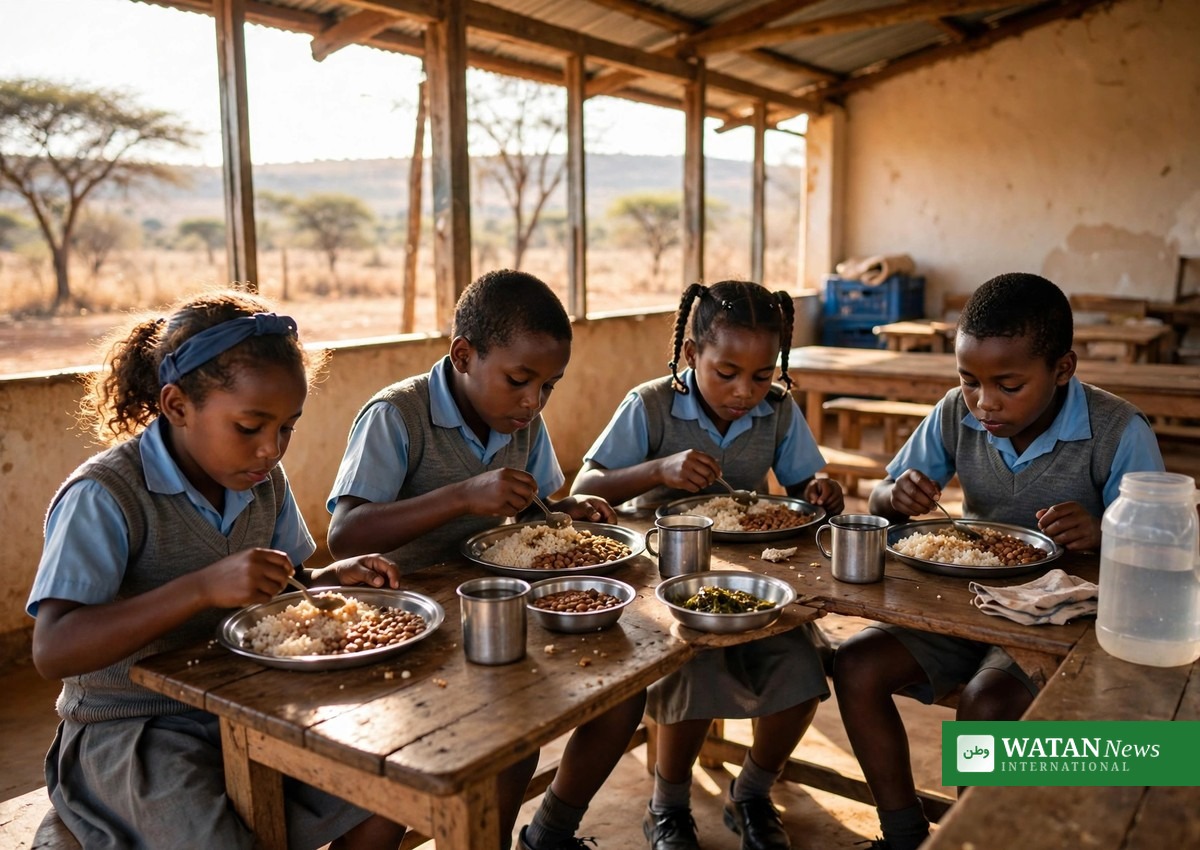
“It touched my heart to see my peers fighting over a plate of rice and beans because the food was inadequate,” he said. “I can only imagine the pain of not having food at home and waiting till break time to get a proper meal at school.”
He asked leaders whether societies could expect children struggling with hunger to become the leaders of tomorrow. “Do we really want to have a leader who is malnourished and hungry?” he asked. “Put the spotlight on us. We want to become the great leaders of tomorrow.”
What the Hungry Futures Index 2.0 found
The Hungry Futures Index 2.0 was developed by World Vision and the University of Galway. It assesses 180 climate policy documents — 84 original nationally determined contributions, 58 updated contributions and 38 national adaptation plans — from 82 countries and the European Union, examining how far governments integrate hunger, food insecurity and malnutrition into their climate plans.
Its headline finding is that hunger is visible in climate policy but rarely prioritised: 73 per cent of countries recognise hunger as a sub-issue, while only 17 per cent identify it as a key issue. Children, the index finds, remain largely absent from climate responses to hunger.
The index was launched as COP31, held in Antalya from 9 to 20 November 2026 under the theme “Towards a Sustainable, Resilient and Equitable Future”, reached its second week.
Inside the negotiators’ closed room
One of Nsibandze’s biggest moments came when the chair of the African Group of Negotiators invited him to address the group, which normally holds closed discussions. According to information shared by the World Vision delegation, he became the first child delegate to receive such an invitation, sharing the platform with a child advocate from Somalia.
He told the gathering that children could not be called the future while their immediate needs, particularly access to adequate food and nutrition, remained unmet. “As adults, you always say we are the future; but before we are the future, we must have fully developed brains and those brains need food to nourish and develop them,” he said.
He also challenged leaders to account for commitments made at previous climate conferences, asking what commitments from the previous five COP meetings had been fulfilled, and noting that the impact of international climate action was not being felt equally across African countries.
He told TRT News that his research had identified 23 countries with policies specifically addressing child hunger and malnutrition, and said the chair of the African Group of Negotiators had expressed a desire to increase that number to at least 35 by the next COP.
Meetings with African leaders
On his fourth day at COP31, Nsibandze was introduced by African Union Commissioner for Agriculture, Rural Development, Blue Economy and Sustainable Environment Moses Vilakati to several high-profile leaders, including Mozambique President Daniel Chapo, Ethiopian Prime Minister Abiy Ahmed Ali and United Nations Economic Commission for Africa Executive Secretary Claver Gatete.
His presence at COP31 coincides with Eswatini’s high-level participation, with Prime Minister Russell Mmiso Dlamini, representing King Mswati III, and Minister of Tourism and Environmental Affairs Jane Mkhonta-Simelane attending the World Leaders Climate Action Summit.
Why child hunger is a climate issue
Nsibandze’s message connects climate change directly to children’s daily lives. In Eswatini, droughts, unpredictable rainfall and other extreme weather conditions threaten food production and household livelihoods, and children who depend on school meals often have no adequate meal at home.
In an interview with TRT News, he said more than half of the country’s children were either poor or malnourished, and pointed to the effects of extreme heat and changing weather patterns on agriculture. “Most recently heatwaves are the most predominant in the country. Heatwaves struck the whole country for about two weeks,” he said, adding that limited awareness of climate change among farmers was compounding the problem.
Young people have been a visible presence throughout COP31, and Nsibandze’s visit follows a week in which they pressed their demands at COP31, including on Children, Youth, Education and Skills Day.
Key facts
- Hlelolwenkhosi Nsibandze, 15, is Eswatini’s first child representative at a UN climate conference and a World Vision Child Ambassador for the ENOUGH Campaign.
- He spoke at a World Vision press conference at COP31 on 11 November 2026, launching the Hungry Futures Index 2.0.
- The index assesses 180 climate policy documents from 82 countries and the European Union; 73 per cent of countries recognise hunger as a sub-issue, only 17 per cent as a key issue.
- He became the first child delegate invited to address the African Group of Negotiators’ usually closed meeting.
- His research identified 23 countries with policies specifically addressing child hunger and malnutrition; the negotiators’ chair wants at least 35 by the next COP.
As the climate discussions continue in Antalya, Nsibandze’s message serves as a reminder that climate change is not only about temperatures, policies and environmental targets. It is also about children who need food on their plates, safe environments in which to grow, and the opportunity to speak for themselves when decisions about their future are made.
Frequently asked questions
Who is Hlelolwenkhosi Nsibandze?
He is a 15-year-old pupil at Evelyn Baring High School in Eswatini and the country’s first child representative at a UN climate conference. He is a World Vision Child Ambassador for the ENOUGH Campaign, vice chairperson of the Eswatini National Children’s Participation and Consultative Forum, and deputy speaker of the SADC Children’s Parliament.
What is the Hungry Futures Index 2.0?
It is an index developed by World Vision and the University of Galway that assesses how far national climate plans address hunger, food insecurity and malnutrition, with particular attention to children. The 2026 edition analyses 180 climate policy documents from 82 countries and the European Union and was launched at COP31 on 11 November 2026.
What did he ask COP31 negotiators to do?
He asked the African Group of Negotiators to place children’s nutrition at the centre of climate action, to include children in climate decision-making, and to account for commitments made at previous COP meetings. He also highlighted that only 23 countries have policies specifically addressing child hunger and malnutrition.
Why is child hunger a climate issue?
Droughts, unpredictable rainfall, heatwaves and other extreme weather threaten food production and household livelihoods, leaving children without adequate food. In Eswatini, many children depend on school meals as their reliable source of food, so climate-driven food insecurity directly affects their health, learning and development.
What happens after COP31 for Eswatini’s children?
At his send-off, Deputy Prime Minister Thulisile Dladla committed the government to promoting meaningful child participation in decision-making and to a post-COP31 action plan that will allow children and young people across Eswatini to benefit from the knowledge and discussions at the conference.
Author

usmanch0013@gmail.com
Related Posts

Eswatinis 15-årige børneambassadør tager kampen for børns mad til COP31-forhandlerne
- 0
- 1,447 word
Femtenårige Hlelolwenkhosi Nsibandze, Eswatinis første børnerepræsentant ved en COP, talte til afrikanske forhandlere ved COP31 i Antalya og opfordrede lederne til at...
Read out all
ایسواتینی کے 15 سالہ بچہ سفیر نے کاپ31 میں بچوں کی بھوک کا معاملہ مذاکرات کاروں تک پہنچا دیا
پندرہ سالہ ہلیلووینخوسی نسیبانڈزے ایسواتینی کے پہلے بچہ نمائندے ہیں جنہوں نے کاپ31 میں افریقی مذاکرات کاروں سے خطاب کیا اور بچوں...
Read out all
Yemen Forces Withdraw from Bab el-Mandeb Area, Leaving Houthis in Control of Vital Strait
- 0
- 574 words
Yemeni government forces have withdrawn from the area overlooking the strategic Bab el-Mandeb Strait, leaving the Houthis in control of one of...
Read out all
69 borgmestre lover et år med klimahandling ved COP31
- 0
- 1,553 word
69 borgmestre, der repræsenterer mere end 250 millioner mennesker, har lovet et år med konkret klimahandling ved COP31 i Antalya, fra varsling...
Read out all
کاپ31 میں 69 میئرز کا ایک سال کی موسمیاتی کارروائی کا عہد، شہر آگے بڑھے
انطالیہ میں کاپ31 کے موقع پر 69 میئرز نے، جو 25 کروڑ سے زیادہ افراد کی نمائندگی کرتے ہیں، ایک سال کی...
Read out all
69 Mayors Pledge a Year of Climate Action at COP31 as Cities Step Up
- 0
- 1,505 word
Sixty-nine mayors representing more than 250 million people have pledged a year of concrete climate action at COP31 in Antalya, from flood...
Read out all