- 0
- 945 words
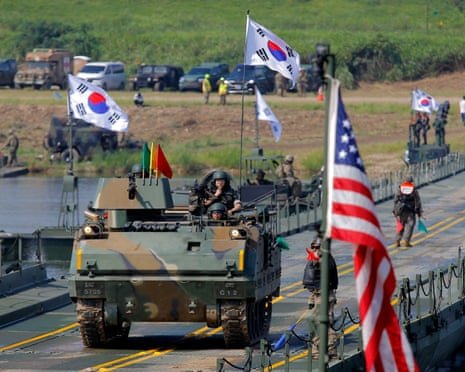
The Philippines has warned that China may reassert itself in the Asia Pacific region amid recent cuts to the joint US-South Korea military drills. Philippine Defence Secretary Gilberto Teodoro expressed concerns that Beijing could view the move as an opportunity to exploit gaps in regional security. The warning comes after the US and South Korea shortened the duration of their annual joint military drills and scaled back field training exercises last month.
The decision to reduce the drills was made by US President Donald Trump, who cited his ‘very good relationship’ with North Korean leader Kim Jong Un. However, Teodoro cautioned that ‘China is very quick to exploit gaps’, and that Washington had given Manila ‘definite assurances’ that the US commitments to the Philippines remained unchanged. He also accused China of exploiting democratic systems to spread ‘distortive narratives’.
- The US and South Korea shortened the duration of their annual joint military drills and scaled back field training exercises last month.
- US President Donald Trump cited his ‘very good relationship’ with North Korean leader Kim Jong Un as the reason for the reduction.
- Philippine Defence Secretary Gilberto Teodoro warned that China may reassert itself in the Asia Pacific region amid the drill cuts.
US-South Korea Military Drills
The US and South Korea have a long-standing military alliance, with annual joint drills aimed at promoting regional peace and stability. However, the recent reduction in drills has raised concerns about the potential impact on regional security. The US-led Ulchi Freedom Shield war games ended six days earlier than originally planned, and the US and South Korea are due to hold five days of military drills in waters east and south of South Korea’s Jeju Island starting on Monday.
China’s Potential Reassertion
Teodoro’s warning about China’s potential reassertion in the Asia Pacific region is not unfounded. China has been increasingly assertive in the region, with a growing military presence and a series of territorial disputes with its neighbors. The Philippines, in particular, has been a key player in the region, with a long-standing dispute with China over the South China Sea. ‘We have to be mindful of the fact that China is very quick to exploit gaps’, Teodoro said.
Regional Implications
The reduction in US-South Korea military drills has significant implications for regional security. The move has been seen as a concession to North Korea, which has long opposed the drills as a provocation. However, it also raises concerns about the potential for China to fill the gap left by the reduced US presence. The Philippines, Japan, and other regional players will be watching the situation closely, as the balance of power in the Asia Pacific region continues to shift.
US Commitments to the Philippines
Despite the reduction in drills, the US has given the Philippines ‘definite assurances’ that its commitments to the country remain unchanged. This is a significant development, as the Philippines has long relied on the US for military support and security guarantees. The US has a mutual defense treaty with the Philippines, and the two countries have a long-standing military alliance. ‘The US has given us definite assurances that their commitments to the Philippines remain unchanged’, Teodoro said.
Future Developments
As the situation in the Asia Pacific region continues to evolve, it is likely that we will see further developments in the coming weeks and months. The US, South Korea, and Japan are due to hold trilateral military drills, and the Philippines will be watching the situation closely. The potential for China to reassert itself in the region is a significant concern, and the US and its allies will need to be mindful of this as they navigate the complex web of regional security dynamics. For more news and analysis, visit Watan News.
Conclusion
In conclusion, the reduction in US-South Korea military drills has significant implications for regional security, and the potential for China to reassert itself in the Asia Pacific region is a major concern. The Philippines, Japan, and other regional players will be watching the situation closely, as the balance of power in the region continues to shift.
FAQs
Q1: What led to the reduction in US-South Korea military drills?
A1: The reduction in drills was made by US President Donald Trump, who cited his ‘very good relationship’ with North Korean leader Kim Jong Un as the reason for the move.
Q2: What are the implications of the drill cuts for regional security?
A2: The reduction in drills has significant implications for regional security, as it raises concerns about the potential for China to fill the gap left by the reduced US presence.
Q3: What has been the response of the Philippines to the drill cuts?
A3: The Philippines has warned that China may reassert itself in the Asia Pacific region amid the drill cuts, and has called for the US to maintain its commitments to the country.
Q4: What is the current state of US-Philippines relations?
A4: The US and the Philippines have a long-standing military alliance, and the US has given the Philippines ‘definite assurances’ that its commitments to the country remain unchanged.
Q5: What are the potential future developments in the region?
A5: The US, South Korea, and Japan are due to hold trilateral military drills, and the Philippines will be watching the situation closely. The potential for China to reassert itself in the region is a significant concern, and the US and its allies will need to be mindful of this as they navigate the complex web of regional security dynamics.
Q6: Where can I find more news and analysis on this topic?
A6: For more news and analysis on this topic, visit Watan News.
Author

usmanjaved13132@gmail.com
Related Posts
Deadly Clashes Erupt Along Sudan-South Sudan Border, Killing at Least 26
- 0
- 503 words
At least 26 people have been killed and 82 others injured in days of intercommunal fighting in a disputed region on the...
Read out all
Foreign Secretary Holds Farewell Interaction with Diplomatic Corps
- 0
- 587 words
Pakistan’s Foreign Secretary, Sohail Mahmood, held a farewell interaction with the diplomatic corps at the Foreign Office in Islamabad, marking the end...
Read out all
COP31 presidency and OECD announce Paris partnership on climate finance and delivery
- 0
- 504 words
President-Designate Murat Kurum frames climate finance as strategic security at OECD headquarters, cites Türkiye’s SURFF urban-resilience facility as an implementation bridge, and...
Read out all
Federal Urdu University launches beginner Russian language course
- 0
- 488 words
The Federal Urdu University of Arts, Science and Technology (FUUAST) has launched a beginner Russian language course. The one month course has...
Read out all
US House passes sweeping Russia sanctions bill, sending it to Trump
- 0
- 684 words
The US House of Representatives on Wednesday approved a sweeping package of sanctions aimed at squeezing Russia’s war economy, sending the legislation...
Read out all
Morocco’s 2026 Election: A Test of Political Trust and Engagement
- 0
- 532 words
Morocco’s 2026 parliamentary election is set to take place on September 23, with 27 political parties vying for 395 seats in the...
Read out all