
- 0
- 1,346 word
ANTALYA: As ministers take over the COP31 climate talks in Antalya on Monday, one of the conference’s most important questions for developing countries remains unresolved: whether wealthy countries will commit to tripling adaptation finance — or merely review the idea. A draft text circulated late on Friday offers both options, and the African Group’s request for a dedicated discussion on the issue has already been refused.
The first draft texts of the second week, issued late on Friday 14 November by the Australian-led presidency, set up the battle that ministers must now settle before the conference closes on Friday 20 November. Technical negotiations under the subsidiary bodies closed on Saturday, with the closing plenary delayed from 5pm to 8pm, and many finance questions still bracketed.
A draft with two very different options
The draft on the Global Goal on Adaptation offers negotiators a choice. One option would triple adaptation finance to at least $120 billion a year by 2035. A second option in the same text would instead open a review of the target’s baseline, size and scope, with findings reported to a later summit.
Reporting on the drafts suggests there is also a third possibility: no text at all on the goal. According to Carbon Brief, earlier versions of the draft included an option defining the baseline at $40 billion in 2025, rising to $120 billion by 2035, and another that would push the discussion into the climate finance work programme.
African delegations are expected to resist the review option, and the Climate Action Network has urged negotiators not to delay the goal. For the countries most exposed to floods, droughts and rising seas, a review that reports to a later summit would mean years without a firm commitment.
Africa’s agenda item refused
The African Group of Negotiators had sought a standalone agenda item on tripling adaptation finance. That request failed to gain consensus during the opening discussions in Antalya. Dr Antwi-Boasiako Amoah of Ghana, who chairs the African Group, confirmed that the proposal was not adopted, with developed countries preferring to handle the question through a broader climate finance work programme. The presidency has said the subject can still be raised under other agenda items.
South Africa’s Environment Minister David Maynier credited the behind-the-scenes work of chief negotiator Maesela Kekana, the African Group and the BASIC group of Brazil, South Africa, India and China with keeping climate finance on the table, according to reporting by the Daily Maverick.
As Oscar Soria of The Common Initiative put it, in comments reported by the Daily Maverick: “Tripling is a word. A baseline, a milestone and a name next to the cheque are a promise.”
The $85 billion or $120 billion question
Part of the dispute is arithmetic. The $120 billion figure comes from the Glasgow Climate Pact agreed at COP26 in 2021, which pledged to double adaptation finance from 2019 levels to about $40 billion a year by 2025. Tripling $40 billion gives $120 billion.
But the COP30 conference in Belém in 2025 called for adaptation finance to at least triple by 2035 without setting a baseline — so the same word now covers a range of about $35 billion a year. Triple the actual flow measured by the United Nations Environment Programme for 2024, $28.2 billion, would be about $85 billion. Triple the Glasgow political target of $40 billion would be $120 billion.
What the UNEP report says
The UNEP Adaptation Gap Report 2026, released on 4 November, puts the scale of the gap in hard numbers. International public adaptation finance reached $28.2–31.7 billion in 2024, only about $1 billion more than in 2023. Developing countries will need about $305 billion a year by 2035, the report says, in a range of $255–328 billion — and up to about $420 billion once inflation is counted.
On those figures, even tripling current flows would cover only 20–29 per cent of developing countries’ needs by 2035. Tripling flows specifically to the least developed countries and small island developing states could cover 49–84 per cent of their needs.
The President of the UN General Assembly, speaking at the COP31 opening on 11 November, put current adaptation funding for developing countries at only about $26 billion a year — a figure that differs from UNEP’s $28.2–31.7 billion, because the two counts measure different things. The UN Secretary-General, António Guterres, has said that even tripling adaptation funding would meet less than 30 per cent of vulnerable countries’ needs.
Key facts
- Draft options: triple adaptation finance to at least $120 billion a year by 2035 — or review the target’s baseline, size and scope instead.
- Actual finance: $28.2–31.7 billion in international public adaptation finance in 2024 (UNEP).
- Needs by 2035: about $305 billion a year for developing countries (UNEP), up to about $420 billion with inflation.
- Coverage: tripling would meet only 20–29 per cent of needs — but 49–84 per cent of needs in the least developed countries and small island states.
- Baseline dispute: “tripling” means about $85 billion from the measured 2024 flow, or $120 billion from the $40 billion Glasgow target.
- Origin of $120bn: the Glasgow Climate Pact (COP26, 2021) pledged to double adaptation finance to about $40 billion a year by 2025.
- Wider goal: at COP29, governments agreed to mobilise at least $300 billion a year by 2035, and called for $1.3 trillion a year from all sources.
The wider finance picture
Adaptation finance is not the only money question in week two. At COP29 in 2024, governments agreed that developed countries would lead the mobilisation of at least $300 billion a year in climate finance for developing countries by 2035, and called for scaling finance from all sources to $1.3 trillion a year. Canada and the United Kingdom restated their backing for that goal at COP31 on 13 November.
The same batch of draft texts issued on 14 November also covered the just transition — the shift to low-carbon economies. That draft proposes a two-tier mechanism whose main outputs are a knowledge hub, reports, an annual meeting and matching requests with existing support. It creates no new money. The Climate Action Network said the text “breaks the promise of Belem” and should be sent back for redrafting, while Chris Bowen, COP31 President of Negotiations, called the draft “comprehensive”.
Read more: COP31 Midpoint: Technical Talks Close in Gridlock as Ministers Take Over for Week Two
What happens next
Ministers now negotiate the most divisive questions, with a first draft of the cover decision expected early next week. The test for adaptation finance will be whether the final text carries a dated, baselined commitment — a number, a year and a starting point — or a review that pushes the decision to a later summit. The conference is due to close on Friday 20 November.
Frequently asked questions
What is adaptation finance?
Adaptation finance is money that helps developing countries adjust to the effects of climate change that are already happening — flood defences, drought-resistant crops, early warning systems, water storage and stronger homes and infrastructure — rather than money to cut emissions.
What does “tripling” adaptation finance mean at COP31?
At COP30 in Belém in 2025, governments called for adaptation finance to at least triple by 2035. The COP31 draft text offers one option to set that at “at least $120 billion a year by 2035”, based on tripling the $40 billion target set at COP26 in Glasgow — or a second option to review the target instead.
Why does the baseline matter so much?
Because “tripling” means different amounts depending on the starting point. Tripling the $28.2 billion actually delivered in 2024, as measured by UNEP, would give about $85 billion a year. Tripling the $40 billion political target from Glasgow would give $120 billion — a difference of about $35 billion a year.
What did the African Group ask for?
The African Group of Negotiators asked for a standalone agenda item on tripling adaptation finance, so the issue would get its own dedicated discussion. The request failed to gain consensus, and the group’s chair, Dr Antwi-Boasiako Amoah of Ghana, confirmed it was not adopted. Developed countries prefer to handle the question through the broader climate finance work programme.
What happens next at COP31?
Ministers take over the most divisive questions in week two, a first draft of the cover decision is expected early next week, and the conference is due to close on Friday 20 November. Whether the final text commits to a tripling figure or orders a review will be one of the key outcomes to watch.
Author

usmanch0013@gmail.com
Related Posts
COP31: Greenpeace’ trojanske hest sætter plastiktraktaten tilbage på dagsordenen
- 0
- 1,390 word
En seks meter høj trojansk hest af træ, der spilder plastikaffald, stod i Konyaalti, Antalya, den 13. november, mens Greenpeace pressede COP31...
Read out all
کاپ31: گرین پیس کا ٹروجن ہارس پلاسٹک معاہدے کو دوبارہ ایجنڈے پر لے آیا
13 نومبر کو کونیا آلتی، انطالیہ میں پلاسٹک کا فضلہ گراتا ہوا چھ میٹر اونچا لکڑی کا ٹروجن ہارس کھڑا تھا، جب...
Read out all
COP31: Greenpeace Trojan Horse Puts Plastics Treaty Back on the Agenda as Final Talks Near
- 0
- 1,367 word
A six-metre wooden Trojan Horse spilling plastic waste stood in Konyaalti, Antalya, on 13 November as Greenpeace pressed COP31 for a strong...
Read out all
COP31: Afrikas kamp for at tredoble tilpasningsfinansieringen er gået i stå — 120 milliarder dollar eller blot en gennemgang?
- 0
- 1,437 word
Ministre åbner COP31's anden uge uden enighed om tilpasningsfinansiering: Et udkast tilbyder en tredobling til mindst 120 milliarder dollar om året i...
Read out all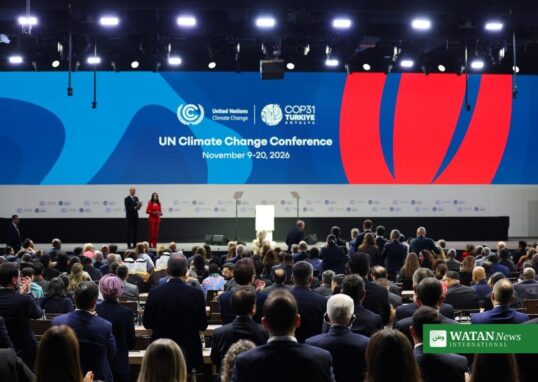
کاپ31: موافقت کی مالی معاونت تین گنا کرنے کی افریقی کوشش رکاوٹ کا شکار — 120 ارب ڈالر کا وعدہ یا صرف جائزہ؟
کاپ31 کے دوسرے ہفتے کا آغاز وزرا کے ساتھ ہوا اور موافقت کی مالی معاونت حل طلب ہے: مسودے میں 2035 تک...
Read out all
Zelensky Says US Raised Donbas Withdrawal for NATO Membership as Ukraine Launches Record Drone Attack
- 0
- 1,146 word
President Volodymyr Zelensky says American negotiators raised the idea of Ukraine withdrawing from Donbas in exchange for NATO membership. The United States...
Read out all